
Blog
Gummi couplings in agriculture: how to choose and quote them
Gummi couplings are key in power transmission for agricultural equipment. In this guide we show you how to identify them, which machines they are used in and what data to send for a quote.
Technical team at MR Accesorios Industriales · Updated on November 8, 2026
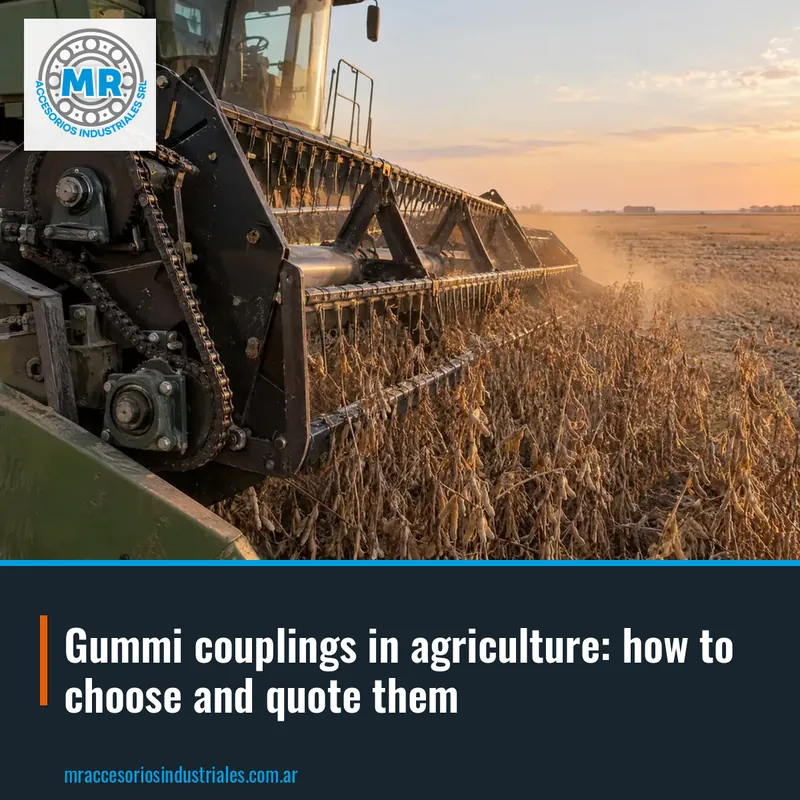
What Gummi couplings are and why they are used in agriculture
Gummi couplings are power transmission elements that join two shafts to transfer movement and torque, absorbing misalignments and vibrations. In agriculture, where machines work under demanding conditions, these components help protect motors, gearboxes and other transmission parts. Being elastic, they compensate for small assembly misalignments and reduce the impact of irregular loads. That is why they are found in equipment such as combine harvesters, seeders, norias and storage plant systems.
The Gummi line includes couplings of different sizes and capacities, suitable for different powers and speeds. Codes A-20, A-60 and A-25 are examples of catalog references. Each has its own dimensions and characteristics that define its suitability for each equipment. When choosing a coupling, it is essential to know the shaft diameter, the power to be transmitted and the available space.
In agricultural machinery maintenance, couplings are often replaced due to wear of the elastic element or breakage under overloads. Having the right spare part avoids long downtime during the campaign. Therefore, correctly identifying the original coupling and its measurements is the first step for an accurate quote. At MR, as an official Gummi distributor, we help you find the correct component for your equipment.
Gummi couplings in combine harvesters
Combine harvesters are complex machines with multiple belt, chain and shaft transmissions. Gummi couplings are used at points where vibrations need to be absorbed or some flexibility allowed, such as in the drive of augers, elevators or threshing systems. A coupling in poor condition can generate noise, excessive vibration and premature wear of bearings and housings. Therefore, during preventive maintenance, the condition of the elastic element and shaft alignment are checked.
To identify the coupling on a combine harvester, look for the code engraved on the metal body or on the flexible element. If it cannot be read, you can measure the outer diameter, total length and diameter of the fixing holes. With that data, at MR we can quote you the exact replacement or its direct equivalent. It is also useful to send a photo of the mounted coupling and the place where it works.
When mounting a new coupling, it is important to respect angular and parallel alignment tolerances. Forced assembly reduces the component's service life and can damage the shafts. It is recommended to verify that the fixing screws are properly tightened and that there is no interference with other parts. If you have doubts about installation, you can consult us and we will guide you through the basic steps.
Gummi couplings in seeders
Seeders require precision in seed and fertilizer dosing. Gummi couplings are used in drive transmissions of dosers, agitators and distribution systems. By absorbing vibrations, they contribute to uniform sowing and prevent breakage of sensitive components. A worn coupling can cause intermittent failures that affect sowing quality.
In seeders, couplings are usually compact in size and located in hard-to-reach places. To order them, it is key to note the manufacturer's code if visible, or measure the shaft diameter and the fixing flange. If you cannot find the code, send us the measurements and a photo, and we will tell you which one corresponds.
When replacing a coupling on a seeder, pay attention to the direction of rotation and the relative position of the holes. Some couplings have a defined mounting direction to maintain balance. It is also advisable to check the condition of the bushings or fixing sleeves, which often wear along with the coupling. At MR we advise you so that the spare part is correct and the machine works smoothly again.
Gummi couplings in norias and elevators
Norias and grain elevators are critical equipment in storage and grain handling plants. Gummi couplings are installed between the gearmotor and the noria shaft to transmit movement smoothly and protect the gearbox from impacts. A rigid coupling in this application would transmit all vibrations and shock loads, shortening the equipment's service life. That is why elastic couplings such as those in the Gummi line are preferred.
In norias, the coupling is often exposed to dust, moisture and temperature changes. It is important to choose a model with the elastic element suitable for those conditions. For a quote, we need the gearmotor shaft diameter, the noria shaft diameter and the distance between flanges.
Maintenance of these couplings includes periodic inspection of the flexible element and verification of screw tightening. If cracks, deformations or uneven wear are observed, it is advisable to replace the complete coupling or the elastic element. At MR we sell Gummi spare parts and help you identify the correct model according to your noria's measurements.
Gummi couplings in storage plants
Storage plants concentrate a large number of grain transport and processing equipment: conveyor belts, augers, screens and dryers. In all these equipment, Gummi couplings serve to join motors with gearboxes or transmission shafts. Correct coupling selection avoids unexpected downtime and reduces maintenance costs.
In a storage plant, it is common to find couplings of different sizes according to the power of each equipment. To identify them, you can use the code engraved on the body or measure their main dimensions. Codes A-20, A-25 and A-60 are examples of catalog references. If you have the equipment manual, it usually lists the original coupling code.
When quoting couplings for a storage plant, it is useful to send a list with the codes or measurements of all the couplings you need. That way, we can prepare a comprehensive proposal and verify the compatibility of each one. It is also important to indicate the brand and model of the equipment where they are mounted, as that facilitates the search. At MR we advise you in each case.
How to identify a Gummi coupling and what data to send for a quote
To order a Gummi coupling, it is ideal to have the exact code that appears on the part. Couplings usually have the model engraved, for example A-20, A-60 or A-25. If the code cannot be read, you can take the main measurements: outer diameter, total length, hole diameter and distance between centers of fixing holes. With that data, at MR we can identify the correct coupling.
In addition to measurements, it is very useful to send a photo of the coupling from different angles, showing the elastic element and the shape of the flanges. If the coupling is mounted, a photo of the assembly helps understand the application. It is also advisable to indicate the brand and model of the machine where it works, and the motor power if known. All that information allows us to quote accurately.
A common mistake when ordering couplings is to rely only on the outer diameter, without considering the length or type of fixing. Another mistake is not checking the condition of associated components, such as keys or screws, which may be damaged. When sending your inquiry, make sure to include all available data and, if you have doubts, ask us. At MR we guide you so that the spare part is correct.
Common mistakes when mounting Gummi couplings and how to avoid them
One of the most frequent mistakes when mounting a coupling is forcing shaft alignment. If the shafts are not aligned within tolerances, the elastic element wears quickly and bearings can be damaged. Before installing, check alignment with a ruler or a dial indicator. It is also important that the shafts are clean and free of burrs.
Another common mistake is tightening the fixing screws unevenly, which generates imbalance and vibrations. It is recommended to tighten in a cross pattern and with the torque indicated by the manufacturer. If the coupling has a keyway, the key must fit well and have no play. Poor adjustment can cause the coupling to loosen during work.
Finally, do not forget to check the condition of the elastic element before mounting a used coupling. If it shows cracks, deformations or hardening, it is advisable to replace it. At MR we sell new Gummi couplings and their spare parts, and we advise you on correct mounting. If you have doubts, you can send us photos of the coupling and the installation site, and we will help you resolve them.
Frequently asked questions
How do I know which Gummi coupling my combine harvester uses?
Ideally, look for the code engraved on the coupling, such as A-20, A-60 or A-25. If it cannot be read, measure the outer diameter, total length and diameter of the fixing holes. With that data and a photo, at MR we quote you the correct replacement.
Can I use a Gummi coupling on a grain noria?
Elastic couplings are installed between the gearmotor and the noria shaft to absorb vibrations and protect the gearbox. We need the shaft measurements and the distance between flanges to quote you the right model.
What measurements do I need to order a Gummi coupling?
The main measurements are: outer diameter, total length, hole diameter and distance between centers of fixing holes. A photo of the coupling and the code if visible are also helpful. With that we identify the exact model.
Do Gummi couplings come with the elastic element included?
It depends on the code. Send the coupling code or its measurements, with a photo, and we will quote you the assembly or the spare part you need.
How do I prevent a Gummi coupling from wearing out quickly?
Premature wear is usually due to shaft misalignment or uneven screw tightening. Check alignment before mounting and tighten in a cross pattern. Also check that the elastic element is in good condition and that there is no interference.
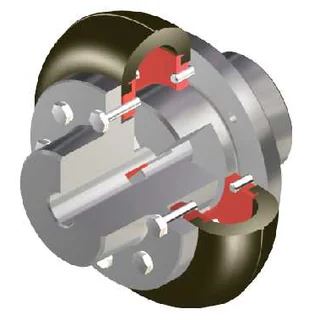
Products with photos in the catalogue
Keep reading
- GUMMI Couplings: Vibration Absorption and Reliable Power Transmission for Industry
GUMMI elastic couplings absorb vibrations and misalignments, protect machinery, and ensure reliable power transmission. Learn about their configurations and how to choose the right model.
- How to Read Gummi Codes: Designation Structure, Prefixes, Suffixes and Real Examples
Practical guide to understand Gummi coupling nomenclature. Decode codes and designations to identify the correct coupling for your application.
- Gummi Couplings: applications, selection and maintenance to make them last
Discover where Gummi couplings are used, how to choose the right model for your application and the best assembly and maintenance practices to extend their service life.
Continue here
Need a GUMMI quote?
Send us the GUMMI part number, the size or a photo of the part and we will get back to you with a quote.