
Blog
Frac sand in Vaca Muerta: how it damages NTN bearings and housings on belts and elevators, and how to protect them
Frac sand is one of the most aggressive contaminants for bearings and housings on conveying equipment in Vaca Muerta. We explain how it gets in, what damage it causes and how to protect them with NTN components.
NTN bearings in Argentina: guide and quotes
Technical team at MR Accesorios Industriales · Updated on November 9, 2026

The frac sand problem in conveying equipment
In Vaca Muerta, frac sand moves on conveyor belts, bucket elevators and screw conveyors. It is a highly abrasive material made of fine, hard particles that embed themselves in any moving surface. The bearings and housings on this equipment are the first to suffer the consequences. The sand acts like constant sandpaper on raceways, rolling elements and seals.
Silica dust gets into the housings and contaminates the grease. Once inside, it accelerates wear and generates heat through friction. A bearing can become unusable before its time if measures are not taken. That is why, in this industry, component selection and preventive maintenance are critical.
NTN SN split housings, combined with spherical roller bearings and adapter sleeves, are a common solution in these applications. Their design allows simple assembly and effective sealing. However, the details must be understood so the sand does not defeat them. In this article we review how to protect them.
SN split housings: the first barrier against sand
The SN split housing is a cast iron part that houses the bearing and fixes it to the structure. Its split design allows the bearing to be mounted and dismounted without dismantling the shaft. In sandy environments, the housing seal is essential to prevent contaminants from entering. NTN offers these housings in various sizes, such as SN508, SN526 or SN607.
On conveyor belts and elevators, housings are often exposed to sand spray. That is why it is advisable to choose versions with suitable covers and seals. A common mistake is not checking the condition of the seals at every plant shutdown. If the seal is worn or misaligned, sand goes straight into the bearing.
To get a quote for an SN housing, it is best to send the full code and the shaft dimensions. For example, SN509 corresponds to a specific shaft diameter. A photo of the damaged part is also useful. That way we can identify the exact model and offer you the correct replacement.
Spherical roller bearings: robustness for loads and misalignment
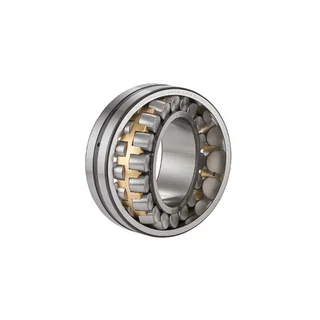
NTN spherical roller bearings are ideal for equipment that suffers misalignment or heavy loads. Their double row of spherical rollers allows them to absorb small shaft deviations. On long conveyor belts, this is key because structures deform with use. Frac sand also increases friction and demands more robust bearings.
Codes such as 21317, 21318 or 21319 are examples of this series. In tapered bore versions they are mounted in SN housings with an adapter sleeve. The combination is widely used on belt pulleys and elevator drums. When choosing a spherical roller bearing, the internal clearance and seal type must be verified.
Periodic relubrication is essential to purge contaminated grease. In sandy environments, greasing more frequently is recommended. If the bearing already shows noise or vibration, it should be replaced before it fails. Send us the code engraved on the side face to get a quote for the replacement.
Adapter sleeves: secure mounting on long shafts
The NTN adapter sleeve is an accessory that allows bearings with a tapered bore to be mounted on cylindrical shafts. It is widely used on conveyor belts and elevators, where shafts are long and difficult to machine. The sleeve slides onto the shaft and is tightened with a nut. This achieves firm and precise fixing.
Examples of sleeves are H3026, H3080 or H3126. Each corresponds to a shaft diameter and a specific bearing series. A common mistake is not respecting the recommended tightening torque. If it is loose, the bearing spins on the shaft and wears. If it is too tight, the inner ring deforms.
In sandy areas, mounting must be done in a clean environment. Any particle left between the sleeve and the shaft compromises the seat. After mounting, alignment and radial clearance should be verified. If you are unsure which sleeve to use, send us the shaft dimensions and the bearing code.
How sand enters the bearing and how to prevent it
Frac sand enters the bearing through three main paths: the seals, relubrication and mounting. The seals of the SN housing can wear or shift with vibration. When greasing, if the grease nipple is dirty, contaminant is injected. And during mounting, if the area is not cleaned well, sand becomes trapped.
To prevent this, the seals must be checked at every maintenance round. It is also advisable to clean the grease nipple before coupling the pump. And when mounting, use clean cloths and degreaser. Another recommended practice is to purge old grease with new grease until it comes out clean through the seal.
On highly exposed equipment, external protections such as deflector plates can be added. There are also housings with special covers for dusty environments. Ask us about these options. With a good maintenance plan, NTN bearings can last much longer in Vaca Muerta.
Relubrication and purging: keys in abrasive environments
Relubrication is the most important action to protect bearings in the presence of sand. Injecting new grease expels contaminated grease through the seals. This is called purging. On conveyor belts and elevators, it is recommended to do it more frequently than in clean environments.
The amount of grease must be controlled. An excess generates heat and can damage the seals. A lack of grease leaves the bearing unprotected. Ideally, follow the equipment manufacturer's recommendations. If you do not have them, you can consult us and we will guide you according to the bearing model.
Always use grease compatible with what is already in the bearing. Mixing incompatible greases can form compounds that do not lubricate. If in doubt, it is preferable to clean and regrease completely. Send us the bearing code, such as 21317 or 23992, and we will indicate the appropriate grease.
What to check in the round and how to order the spare part
On the daily round, pay attention to noise, vibration and temperature in the housings. A bearing with sand makes a rough sound, as if it had dirt inside. Temperature can be measured with an infrared thermometer. If one housing is hotter than the others, it is a sign of a problem.
Also visually check the seals and covers. If you see dark grease coming out, it is because it is contaminated. Note the bearing and housing code before disassembling. For example, the SN526 housing together with the bearing and sleeve code. That information is key to ordering the correct spare part.
To get a quote, send us the code or a photo of the part via WhatsApp. Shaft and housing dimensions are also useful. At MR we are official NTN distributors and we manufacture split housings under our EMMAR brand in SN, SNL, SONL, SAF, FNL, TVN and 722500 series. The codes mentioned in this article are NTN, not EMMAR. We will reply as soon as possible.
Frequently asked questions
Which bearing is suitable for a conveyor belt in Vaca Muerta?
It depends on the shaft diameter and the load. In general, NTN spherical roller bearings are used, such as those in the 213 series, mounted on SN split housings with an adapter sleeve. Send us the shaft dimensions and load so we can recommend the exact model.
How do I prevent sand from entering the bearing?
Check the housing seals periodically, clean the grease nipple before greasing and purge old grease frequently. You can also add external protections such as deflectors. Good sealing is the first barrier.
How often should relubrication be done in sandy environments?
More frequently than in clean environments. Sand contaminates the grease quickly, so intervals should be shortened. Purging should be done until clean grease comes out through the seals. If you are unsure, consult us with the bearing code.
What is an adapter sleeve and what is it for?
It is an accessory that allows bearings with a tapered bore to be mounted on cylindrical shafts. It is used on long shafts of belts and elevators. It is tightened with a nut and fixes the bearing to the shaft without the need to machine the shaft.
Can I use EMMAR housings with NTN bearings?
Yes, the EMMAR split housings we manufacture at MR are compatible with NTN bearings of the corresponding series. The example codes in this article are NTN. If you have doubts, send us the bearing code and we will indicate the appropriate housing.
Products with photos in the catalogue
Keep reading
- NTN in oil & gas: applications in pumping, compression and surface equipment
How to select NTN bearings for the oil and gas industry: tapered rollers, angular contact, inserts and more.
- How to Read NTN Codes: Structure, Prefixes, and Suffixes
Understanding the designation of an NTN bearing allows you to identify its features and order the correct replacement. We explain the basic nomenclature and the most common suffixes.
- How to Choose NTN Bearings by Application: Load, Speed, Environment and Mounting
Choosing the right NTN bearing involves analyzing load, speed, environment and mounting. We show you what to consider and real catalog codes for each case.
Continue here
Need a NTN quote?
Send us the NTN part number, the size or a photo of the part and we will get back to you with a quote.