
Blog
Donghua chain assembly and disassembly: tools, steps and common mistakes that shorten service life
Practical guide to assembling and disassembling Donghua roller chains in industrial equipment. Necessary tools, safe steps and mistakes to avoid.
DONGHUA catalog by part number
Technical team at MR Accesorios Industriales · Updated on October 26, 2026
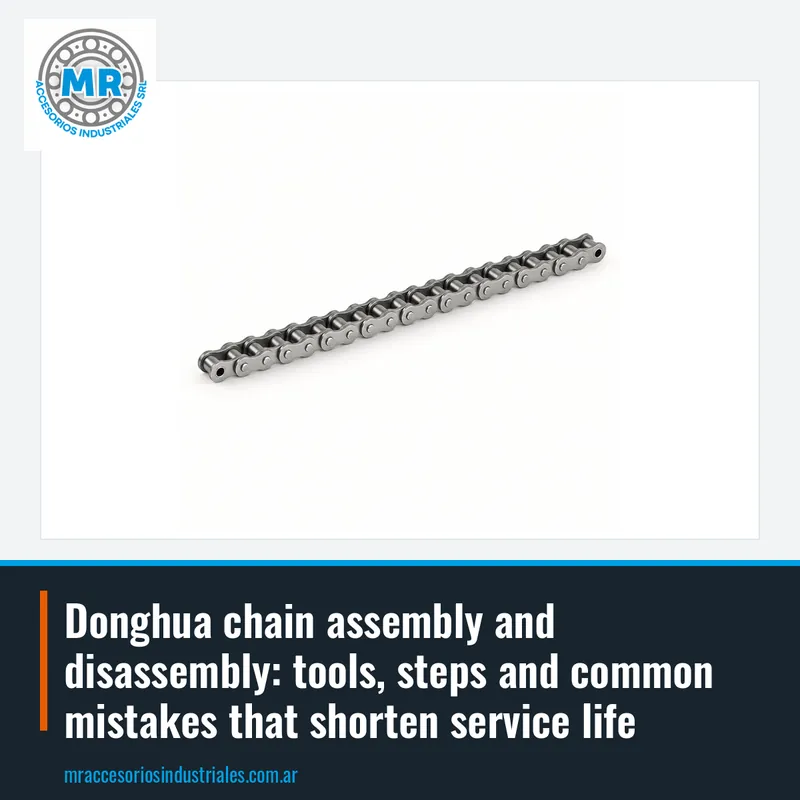
Why correct assembly defines the service life of a Donghua chain
Donghua chain assembly and disassembly is a frequent task in industrial maintenance, but it is not always done with the necessary care. A poorly installed chain can fail prematurely, damage the sprockets and cause unplanned downtime. That is why it is worth reviewing the basic steps and the right tools before working on equipment. In this guide we tell you how to do it safely and which mistakes to avoid.
Donghua roller chains, such as the ASA 60, ASA 80 or ASA 50 series, are used in conveyors, agricultural machinery, elevators and power transmission equipment. Each application has its particularities, but the assembly principles are similar. A good procedure reduces wear, avoids overloads and maintains correct alignment between shafts. It also makes future disassembly easier when replacement time comes.
When working with Donghua chains, it is important to identify the exact chain code before starting. For example, an ASA 60 chain has a 3/4-inch pitch, while an ASA 80 has a 1-inch pitch. That information is stamped on the links or on the equipment identification plate. If you have doubts, you can send us a photo of the chain or the code and we will help you confirm it.
Basic tools for assembling and disassembling Donghua chains
To disassemble a Donghua chain you need a chain puller or a detachable link, depending on the type of joint. Press-fit connecting links require a specific puller that pushes the pin out of the bushing. On larger chains, such as ASA 80, a hydraulic puller or a manual press may be necessary. Never use direct hammer blows on the pins, because you deform the components and compromise the strength of the chain.
Assembling a new Donghua chain is usually done with a connecting link or clip link. To close the chain, align the ends, insert the connecting link and fit the safety clip with the opening facing opposite to the direction of chain movement. If the chain has a large pitch or works under high loads, it is better to use a riveted connecting link, which is closed with a special tool to deform the pin.
In addition to the specific tools, you need measuring and alignment elements. A metal ruler or a caliper is useful to verify that the shafts are parallel and that the sprockets are aligned in the same plane. A tension gauge or a simple method to measure chain sag once assembled is also useful. A chain that is too tight or too loose accelerates wear and can jump off the sprocket.
Steps to disassemble a Donghua chain without damaging the components
Before disassembling a Donghua chain, lock out the equipment to prevent accidental movement and release the chain tension. If the system has a tensioner, loosen it until the chain is slack. Then locate the connecting link: it is recognized by the safety clip or by the pins with a different head. If the chain has no visible connecting link, you will have to cut a link with a puller or a grinder, but that means replacing that link with a new one when reassembling.
To remove the clip-type connecting link, take off the clip with a small screwdriver or pliers, being careful not to deform it. Then remove the outer plate and push the pins outward. If the clip is very stiff, use a clip puller or apply a little penetrant, but never hit it hard. On chains with a riveted link, disassembly requires cutting the link or using a puller that breaks the rivet in a controlled way.
Once the chain is separated, check the condition of the links, pins and bushings. If you see uneven wear, corrosion or cracks, it is time to replace the entire chain. It is not advisable to mix new and old links, because differences in pitch generate irregular loads. When disassembling, mark the position of the chain and sprockets if you plan to reassemble the same chain, so as to respect the original direction of rotation.
How to assemble a new Donghua chain on the equipment
To assemble a new Donghua chain, first verify that the sprockets are in good condition. A sprocket with worn or deformed teeth ruins a new chain in a short time. If the sprockets are fine, place the chain around both sprockets, leaving the ends close together to join them. If the chain is very long, you can use a support or a guide to prevent it from twisting during assembly.
Join the ends with the corresponding connecting link. If you use a clip link, insert the pins into the bushings, fit the outer plate and then the clip. The clip opening must face opposite to the chain travel, so that centrifugal force does not expel it. If you use a riveted link, you need a tool that deforms the end of the pin until it forms a secure head. Verify that the connecting link turns freely and does not remain stiff.
After closing the chain, adjust the tension according to the equipment manufacturer's specifications. In general, a sag is left that allows slight chain movement, but that depends on the application. Excessive tension overloads the bearings and accelerates chain wear. Insufficient tension causes vibrations and can make the chain jump. Turn the equipment manually a few revolutions to check that the chain seats well on the teeth.
Common mistakes that shorten the service life of Donghua chains
One of the most frequent mistakes is using unsuitable tools to disassemble or assemble the chain. Hitting the pins with a hammer and punch deforms the bushings and creates friction points. Another mistake is not correctly aligning the shafts and sprockets. A misalignment of just a few millimeters produces lateral wear on the plates and teeth, and noticeably reduces chain life.
It is also common to reuse old connecting links or deformed clips. The safety clip loses tension after several uses and can come off during operation. If you disassembled the chain with a puller and damaged the link, replace it with a new one. Do not try to straighten a bent clip or reuse a pin that has already been pressed out. It is always better to replace them: a production failure costs much more.
Another important mistake is not lubricating the chain after assembly. In service, the chain needs a lubrication plan suited to the speed and load. Lack of lubrication is the main cause of premature wear in roller chains. Nor should you over-tension: a chain that is too tight works under constant overload and can break a link or damage the shafts.
How to identify your Donghua chain to order the correct replacement
To order a new Donghua chain, you need to identify the exact code. On most chains, the code is stamped on the outer plates every certain number of links. For example, you may see ASA 60, ASA 80 or ASA 50. That code indicates the chain series and pitch. If you cannot find the code, measure the pitch between pins with a caliper and compare it with a standard measurement table.
In addition to the code, it is advisable to count the number of links or measure the total length of the chain. Some applications use chains with special links or with welded attachments, such as conveyor extensions. In those cases, take photos of the complete chain and of the details of the special links. Also note the width between inner plates, because there are chains with the same pitch but different width.
If you have doubts about the code or measurements, you can send us a photo of the chain and the equipment identification plate. At MR we sell Donghua chains and help you confirm the exact model. With the code and the number of links, we will quote the chain promptly. We also tell you whether it is advisable to order additional connecting links or assembly tools.
Preventive maintenance after assembling Donghua chains
After assembling a new Donghua chain, it is important to monitor it during the first hours of operation. The chain may stretch slightly during initial seating, so it is advisable to check the tension after the first day of work. If the chain is too loose, adjust it; if it is too tight, loosen the tensioner. Take the opportunity to verify that the connecting link clip is still in place and that there are no signs of abnormal rubbing.
The lubrication plan is key to extending service life. Donghua chains in power transmission applications are usually lubricated with oil, while in low-speed conveyors grease or spray lubricant can be used. The frequency depends on working conditions: dusty, humid or high-temperature environments require more frequent lubrication. A well-lubricated chain reduces internal friction and prevents wear of pins and bushings.
It is also advisable to periodically inspect the condition of the sprockets and the alignment. If you see that the teeth become sharp or wear on only one side, it is a sign of misalignment or incorrect tension. Correct the problem before it damages the new chain. If you need spare parts or advice on Donghua chains, at MR we will quote the exact model just by sending us the code or a photo of the part.
Frequently asked questions
How do you disassemble a Donghua chain with a connecting link?
First release the chain tension and locate the connecting link, which is recognized by the safety clip. Remove the clip with a screwdriver or pliers, remove the outer plate and push the pins outward. If the clip is stiff, use a clip puller or a little penetrant, but do not hit it.
What tools do I need to assemble a Donghua ASA 80 chain?
For an ASA 80 chain you need a chain puller or a manual press to close the connecting link, if it is riveted. If you use a clip link, a screwdriver and pliers are enough. It is also advisable to have a ruler to verify alignment and a tension gauge.
Can I reuse the safety clip of a Donghua chain?
It is not recommended to reuse safety clips, because they lose tension after each assembly and can come off during operation. Always use a new clip when assembling the chain. If the clip is deformed or does not fit well, replace it with one of the same size.
How do I know if my chain is Donghua ASA 60 or ASA 50?
The code is stamped on the outer plates of the chain. If you cannot find it, measure the pitch between pins: ASA 60 has a 3/4-inch pitch and ASA 50 has a 5/8-inch pitch. You can also send us a photo of the chain and we will help you identify it.
How often should a Donghua chain be lubricated?
It depends on the application and working conditions. In general, follow the equipment manufacturer's lubrication plan. In dusty or humid environments, the frequency should be higher. Proper lubrication is key to avoiding premature wear.
Products with photos in the catalogue
Keep reading
- Donghua in Argentina: product guide, uses and how to quote by code
Learn about Donghua roller chains, their applications in Argentine industry and how to request a quote by code or size.
- How to Read Donghua Codes: A Practical Guide to Roller Chain Designation
Understanding Donghua chain nomenclature allows you to identify pitch, series, and construction features. We explain the code structure with real examples.
- Donghua Chains: Applications, Selection and Maintenance for Industry
Donghua roller chains are used in power transmission and conveying across multiple industries. Learn how to select the right series and what maintenance to apply so they last longer.
Continue here
Need a DONGHUA quote?
Send us the DONGHUA part number, the size or a photo of the part and we will get back to you with a quote.