
Product page
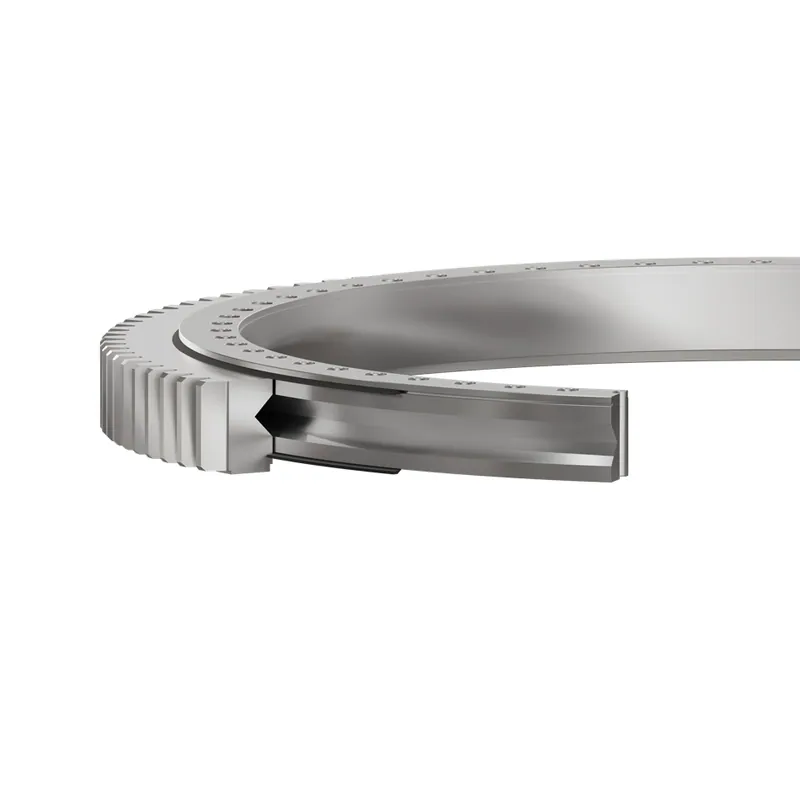
Slewing ring TECMA DRIVE E.1805.45.17.D.3-R
- Manufacturer Part Number
- E.1805.45.17.D.3-R
- Brand
- TECMA DRIVEOfficial distributor
- Category
- Power transmission
- Subcategory
- Slewing rings

We respond promptly.
Request your quote via WhatsApp or email, with the quantity and time frame you need.
Can't find the exact model? Write to us with the part number or model you're looking for: we'll find it and quote it, even if it's not listed in the catalog.
Description
TECMA DRIVE E.1805.45.17.D.3-R is a slewing ring reference, within Power transmission. Request a quote for E.1805.45.17.D.3-R via WhatsApp or email with the quantity you need; we respond promptly with lead time and equivalents.
The slewing ring is a power transmission component that enables rotary motion of structures or platforms on a vertical or horizontal axis. It is used in equipment that requires precise orientation and support of combined loads, such as cranes, lifting platforms or rotary tables. MR Accesorios Industriales offers TECMA DRIVE slewing rings with external teeth, available in different configurations according to each model's code.
The designation of TECMA DRIVE slewing rings with external teeth is structured with letters and numbers that identify dimensions and characteristics. For example, in E.1390.30.15.D.1-R and E.1805.45.17.D.3-R, the first numeric block after the letter E indicates the reference diameter, the second the number of teeth or the pitch, and the suffixes D and R indicate construction variants such as the tooth type or treatment. Each combination defines a specific model that is quoted by its full code.
These slewing rings are used in industries such as metallurgy, construction, mining and material handling. In Argentina, they are common in tower cranes, aerial work platforms, cutting tables and rotation equipment for production lines. Their function is to enable controlled rotation of heavy parts with smooth, wear-resistant transmission, integrating with sprockets and drive systems.
To select a slewing ring, take into account the axial and radial load it must support, the tilting moment and the environmental conditions. Mounting requires a flat, rigid support surface and careful alignment with the sprocket to avoid premature wear. Proper lubrication of the teeth and internal bearings is key to extending service life. If the equipment operates with dust or humidity, consider additional protections.
Slewing rings may have equivalences between different manufacturers, but interchangeability depends on mounting dimensions, tooth module and load capacity. It is not enough for the code to be similar: drawings and technical specifications must be verified. At MR Accesorios Industriales we can guide you to find the right slewing ring for your application, comparing functional characteristics.
If you need a TECMA DRIVE slewing ring, send us the full code via WhatsApp. With that information, our technical team identifies the model and sends you the quote promptly. We can also advise you if you have doubts about the designation or want to evaluate an alternative for your equipment.
This description provides guidance on the product type. Check the configuration and dimensions of this reference.
Dimensions
Dimensions and tolerances: Send us the part number via WhatsApp and we'll confirm dimensions, sealing, and internal clearance against the manufacturer's data sheet.
Frequently Asked Questions
- How do I identify the slewing ring model I need?
- The full code, such as
E.1390.30.15.D.1-R, includes diameter, number of teeth and variants. If you do not have it, send us the main measurements or a photo of the component and we will help you identify it. - What applications do slewing rings with external teeth have?
- They are used in equipment requiring controlled rotation: cranes, lifting platforms, rotary tables, excavators and orientation systems. The external teeth facilitate drive by sprocket and allow high torques to be transmitted.
- How are slewing rings lubricated?
- Both the teeth and the internal bearings are lubricated with specific grease or oil. The frequency depends on the application and the environment. It is important to follow the manufacturer's recommendations to avoid premature wear.