
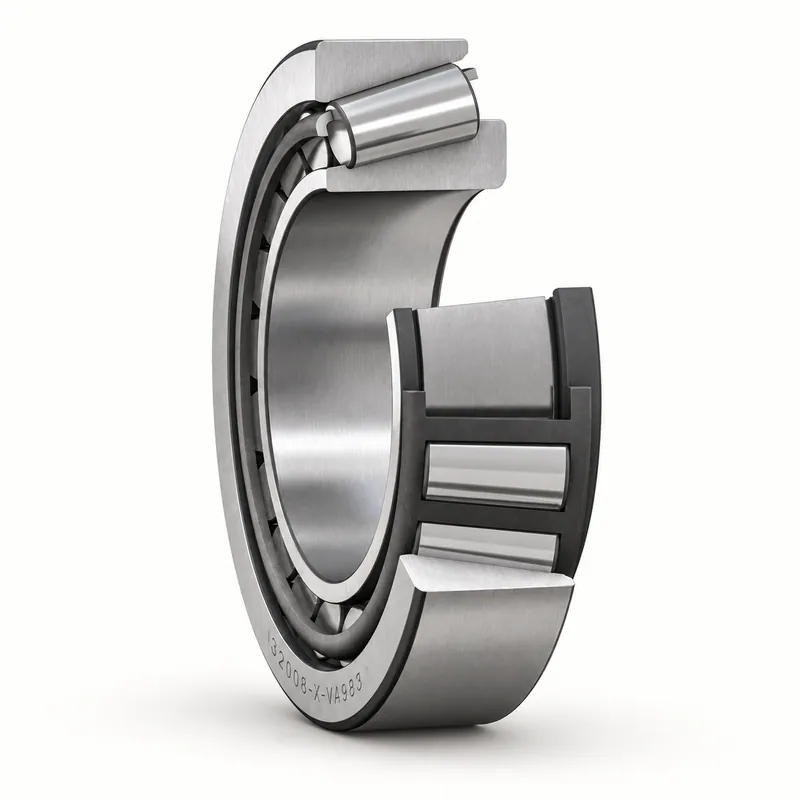

SKF T7FC 095/CL7CVQ051 tapered roller bearing
- Brand
- SKF
- Category
- Bearings
- Subcategory
- Tapered roller bearings
We respond promptly.
Request your quote via WhatsApp or email, with the quantity you need.
Other brands in this category
Ask us about alternatives. Equivalence is verified for each reference and application.
Can't find the exact model? Write to us with the part number or model you're looking for: we'll find it and quote it, even if it's not listed in the catalog.
Description
SKF T7FC 095/CL7CVQ051 is a reference of tapered roller bearing, within Bearings. Request a quote for T7FC 095/CL7CVQ051 via WhatsApp or email with the quantity you need; we respond promptly with the quote and equivalents.
SKF tapered roller bearings are components designed to support combined radial and axial loads, with a geometry that allows linear contact between rollers and raceways. They are used in applications where precision and load capacity are critical, such as transmissions, wheel shafts and gear systems. MR Accesorios Industriales sells and distributes this line in Buenos Aires, Argentina, with more than 80 years of experience in the field.
The designation of this series is read from the complete code, as in the example T7FC 095/CL7CVQ051. The prefix T7FC identifies the tapered roller series, while the number 095 corresponds to the bore diameter. The characters after the slash, such as CL7CVQ051, are part of the specific designation of each execution. To request a quote, simply provide the complete code that appears in your list or on the part.
These bearings are used in a wide variety of industries in Argentina, including automotive, agricultural machinery, mining and the metallurgical industry. They are common in transmission housings, gearboxes, wheel shafts, machine tool spindles and earthmoving equipment. Their ability to support combined loads makes them suitable for assemblies where radial and axial forces occur simultaneously.
To select the correct bearing, take into account the radial and axial load it will have to support, as well as the rotation speed and environmental conditions. Mounting requires precise alignment and adequate lubrication to ensure performance. It is important to verify the axial fit and internal clearance according to the type of application. Correct installation and periodic maintenance extend the service life of the component.
When replacing a tapered roller bearing, it is common to find equivalents between different brands. If you have the code of another brand or an unidentified part, we can help you find the corresponding SKF reference. Interchangeability depends on dimensions and tolerances, so it is essential to have precise technical data. At MR we advise you so that the replacement is reliable.
If you need to request a quote for an SKF tapered roller bearing, send the code or the exact size via WhatsApp to MR Accesorios Industriales. We will reply shortly with the information you need for your order. We can also advise you if you have doubts about the designation or the application.
Dimensions
Dimensions and tolerances: Send us the part number via WhatsApp and we'll confirm the dimensions and version against the manufacturer's data sheet.
Frequently Asked Questions
- What type of loads do SKF tapered roller bearings support?
- They are designed to support combined radial and axial loads, thanks to the inclined arrangement of their rollers. They are ideal for applications where forces occur in both directions, such as transmissions and wheel shafts.
- How can I identify the correct code of a tapered roller bearing?
- The complete code includes a series prefix, a number indicating the bore diameter and suffixes that identify the execution. For example, in
T7FC 095/CL7CVQ051, the prefix is T7FC and the number 095 corresponds to the bore. - What should I take into account when mounting a tapered roller bearing?
- It is essential to ensure precise alignment, adequate lubrication and the correct axial fit. The internal clearance must also be verified according to the application and the manufacturer's recommendations must be followed to avoid premature failures.