
Product page
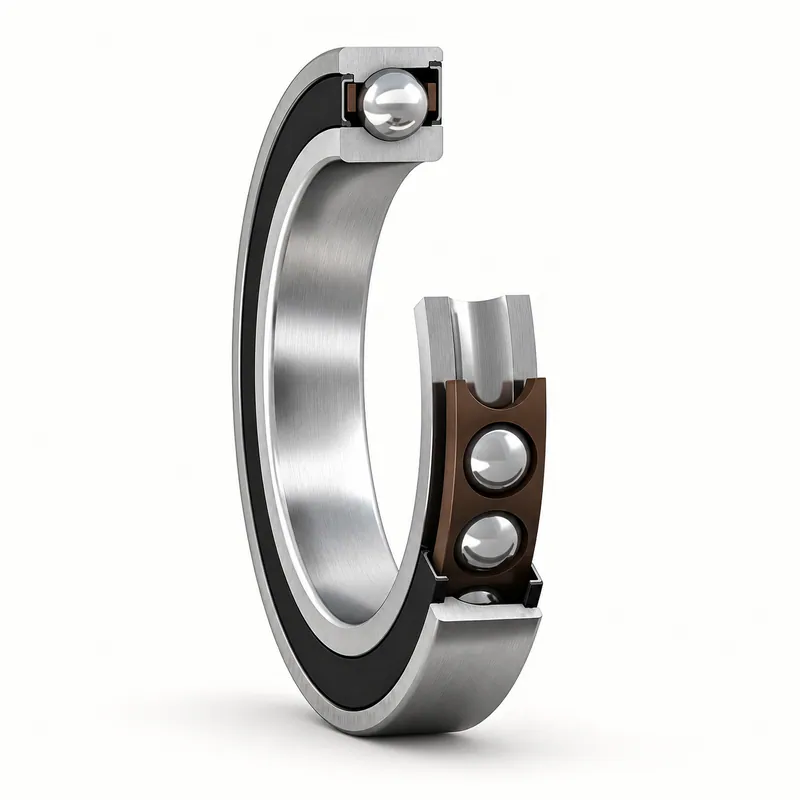
Angular contact ball bearing SKF S7009 FE/DBBVQ126
- Manufacturer Part Number
- S7009 FE/DBBVQ126
- Brand
- SKFOfficial brand
- Category
- Bearings
- Subcategory
- Angular contact ball bearings
Other brands in this category
- FAG
- NTN
- TIMKEN
Ask us about alternatives. Equivalence is verified for each reference and application.

We respond promptly.
Request your quote via WhatsApp or email, with the quantity and time frame you need.
Can't find the exact model? Write to us with the part number or model you're looking for: we'll find it and quote it, even if it's not listed in the catalog.
Description
SKF S7009 FE/DBBVQ126 is a angular contact ball bearing reference, within Bearings. Request a quote for S7009 FE/DBBVQ126 via WhatsApp or email with the quantity you need; we respond promptly with lead time and equivalents.
SKF angular contact bearings are components designed to support combined radial and axial loads. Their design with oblique contact raceways allows superior performance in applications where precision and rigidity are critical. At MR Accesorios Industriales we supply this line for industrial equipment that requires high accuracy and reliability. If you need assistance identifying the right model, our technical team is available to help you.
The designation of these bearings combines letters and numbers that indicate key characteristics. For example, in S7009 FE/DBBVQ126, the letter S indicates a high-capacity design, while 7009 identifies the size and series. The suffix FE indicates a special execution, and DBBVQ126 specifies the internal clearance, preload and other particularities. Knowing these codes is essential to select the correct bearing according to the operating conditions.
These bearings are used in applications that require supporting combined loads and high speed, such as machine tool spindles, pumps, compressors, gearboxes and power transmission equipment. In Argentina, they are common in the metalworking, food and petrochemical industries, where precision and durability are essential to maintain productivity.
To select the right bearing, take into account the magnitude and direction of the loads, the rotation speed and the environmental conditions. Mounting must ensure precise alignment and adequate lubrication. Seals and internal clearance influence performance and service life. Follow the manufacturer's recommendations for mounting and lubrication, and periodically check the condition of the bearing.
When looking for equivalences with other brands, it is important to compare dimensions and load capacities, not just the code. Series may have different designations between manufacturers, but bearings are interchangeable if the technical specifications match. Always consult a specialist to validate compatibility.
To request a quote for the bearing you need, send the full part number by WhatsApp to MR Accesorios Industriales. Our technical team will advise you so you can find the right solution for your application.
This description provides guidance on the product type. Check the configuration and dimensions of this reference.
Dimensions
Dimensions and tolerances: Send us the part number via WhatsApp and we'll confirm dimensions, sealing, and internal clearance against the manufacturer's data sheet.
Frequently Asked Questions
- What does the FE suffix mean in the designation?
- The FE suffix indicates a special execution of the bearing, which may include variations in the raceway design, the cage type or the heat treatment. These modifications optimize performance for specific applications, such as high speed or particular loads.
- How do I choose between an angular contact bearing and a radial one?
- The choice depends on the loads it must support. Angular contact bearings are designed for combined radial and axial loads, while simple radial bearings mainly support radial loads. If your application has significant axial load, the angular contact bearing is the right option.
- Can I replace an SKF bearing with one from a different brand?
- Yes, as long as the dimensions and load capacities are equivalent. It is essential to verify the technical specifications and the type of execution. We recommend consulting our technical team to ensure compatibility and correct operation.