
Product page
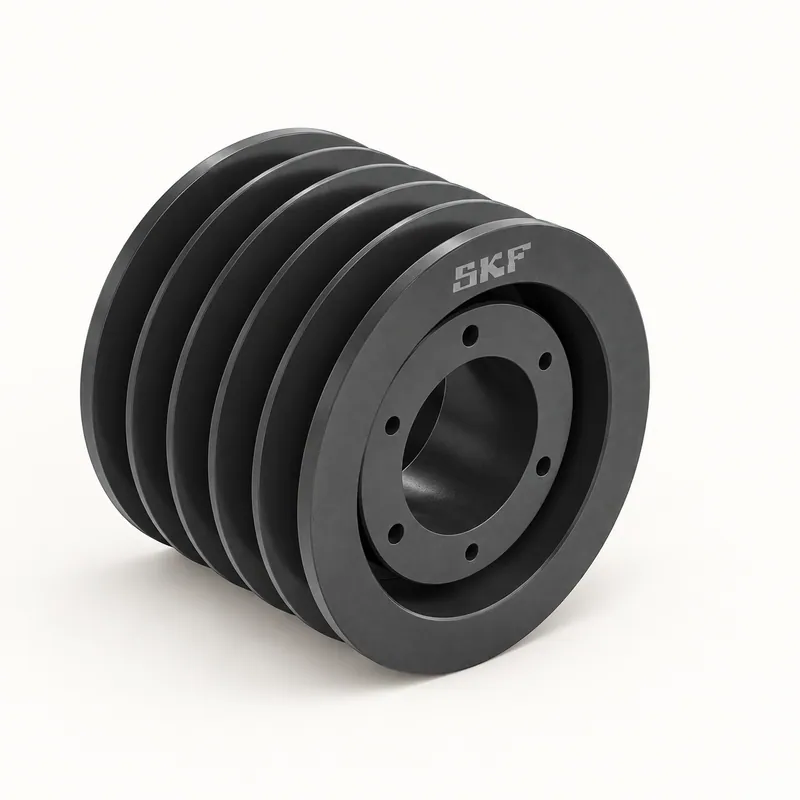
Drive pulley SKF PHP 8-B124-E
- Manufacturer Part Number
- PHP 8-B124-E
- Brand
- SKFOfficial brand
- Category
- Power transmission
- Subcategory
- Pulleys and V-belts

We respond promptly.
Request your quote via WhatsApp or email, with the quantity and time frame you need.
Can't find the exact model? Write to us with the part number or model you're looking for: we'll find it and quote it, even if it's not listed in the catalog.
Description
SKF PHP 8-B124-E is a drive pulley reference, within Power transmission. Request a quote for PHP 8-B124-E via WhatsApp or email with the quantity you need; we respond promptly with lead time and equivalents.
SKF drive pulleys are essential components for power transmission in industrial machinery. This system, based on the V-profile, transmits motion between shafts efficiently and with low maintenance. They are used in a wide variety of applications, from fans and pumps to compressors and conveyors. At MR Accesorios Industriales we stock the complete line so you can build or replace your drive with confidence.
The designation of these pulleys and belts follows a clear scheme. For example, PHP 3-B380-E indicates a 3-groove pulley for a B-section belt with a pitch diameter of 380 mm. The suffix -E indicates that the pulley comes with a taper bushing for quick mounting. Other examples such as PHP 4-B250-E or PHP 6-B200-E show variations in the number of grooves and diameter. Knowing this nomenclature lets you quickly identify the component you need.
These systems are used in industries such as food, chemical, cement and water treatment. In Argentina, they are commonly found in animal feed plants, flour mills, silo plants and forced ventilation systems. Also in pumping equipment and screw compressors. The robustness of SKF pulleys and the variety of V-belts make them ideal for environments with dust, humidity or variable loads.
To select correctly, take into account the power to be transmitted, the RPM of the fast and slow shafts, and the center distance. The belt section (A, B, C, D) must match that of the pulley. Check pulley alignment with a straightedge or laser to avoid premature wear. Belt tension must be adequate: too loose slips, too tight overloads the bearings. Lubricate the taper bushings as indicated by the manufacturer and check the sealing for dusty environments.
SKF pulleys are interchangeable with other brands that follow the ISO standard for V-sections. When replacing, compare the pitch diameter, the number of grooves and the type of bushing. V-belts are also standardized, so you can use any brand that complies with the standard. If in doubt, the code stamped on the original pulley or belt is the best reference. Do not invent measurements: always verify with the old component.
To request a quote for SKF drive pulleys, send us the exact code via WhatsApp. At MR Accesorios Industriales we reply with the technical advice you need. Whether it is a single part or a complete assembly: we are here to help you keep your production running.
This description provides guidance on the product type. Check the configuration and dimensions of this reference.
Dimensions
Dimensions and tolerances: Send us the part number via WhatsApp and we'll confirm dimensions, sealing, and internal clearance against the manufacturer's data sheet.
Frequently Asked Questions
- What does the -E suffix mean on an SKF pulley?
- The -E suffix indicates that the pulley includes a taper bushing for quick mounting. This bushing allows the pulley to be fixed to the shaft easily and safely, facilitating assembly and disassembly without the need for a press.
- How do I choose the right belt section?
- The belt section must match that of the pulley. The most common sections are A, B, C and D. Check the pulley code: for example, if it says B, you need a B-section belt. If in doubt, ask us with the code.
- How often should I check belt tension?
- It is recommended to check tension periodically, especially in the first 24 hours of operation and then every 500 hours. Incorrect tension accelerates wear on the belt and bearings. Use a tension gauge or the deflection method.