
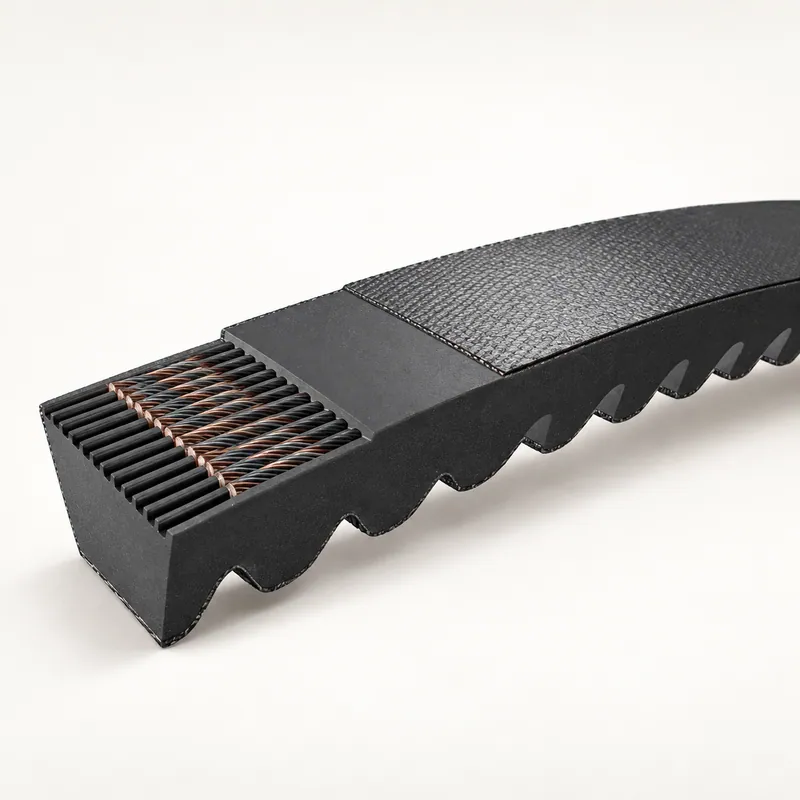

SKF PHG D-900-H-200 timing belt
- Brand
- SKF
- Category
- Power transmission
- Subcategory
- Timing belts
We respond promptly.
Since 1945 · Martínez, Buenos Aires, Argentina
Request your quote via WhatsApp or email, with the quantity you need.
Can't find the exact model? Write to us with the part number or model you're looking for: we'll find it and quote it, even if it's not listed in the catalog.
Description
SKF PHG D-900-H-200 is a reference of timing belt, within Power transmission. Request a quote for PHG D-900-H-200 via WhatsApp or email with the quantity you need; we respond promptly with the quote and equivalents.
SKF PHG D-H series timing belts are power transmission components that combine the flexibility of a belt with the precision of a gear. Their internal teeth mesh with grooved pulleys, ensuring a constant, synchronized transmission ratio without slipping. They are used in applications where rotational accuracy and repeatability are critical, from machine tools to automation equipment. MR Accesorios Industriales sells this line as part of its power transmission catalog.
The designation of a belt in this series is interpreted as follows: PHG identifies the SKF timing belt family; D indicates the tooth profile (pitch and geometry); the following number is the pitch length in tenths of an inch; H corresponds to the nominal pitch of 1/2 inch; and the last number is the width in hundredths of an inch. Examples in the series, such as PHG D-240-H-100 or PHG D-270-H-150, show how length and width vary according to the need. This nomenclature makes it possible to quickly identify the right belt for each pulley.
These belts are used in industries such as food, textile, paper, plastics and automation. In Argentina, they are common in packaging machines, industrial printers, compressors, pumps and precision transmission equipment. They also appear in applications requiring synchronization between shafts, such as positioning or conveying systems. Their wear- and fatigue-resistant construction makes them suitable for continuous duty. MR Accesorios Industriales offers them for replacement and new projects.
To correctly select a timing belt, take into account the tooth profile, the pitch length and the width. Verify that the pulley has the same pitch and the appropriate number of teeth. Installation requires aligning the pulleys and tensioning the belt according to the manufacturer's specifications; excessive tension accelerates wear on the teeth and bearings, while low tension causes tooth jumping. Lubrication does not apply to these belts, but keeping the environment clean does to avoid abrasive contaminants.
As for equivalences, SKF PHG D-H series timing belts can be interchanged with other brands that use the same profile and pitch, such as those designated H (1/2" pitch). It is essential to compare the full designation: pitch length and width must match to ensure correct operation. Not all brands use the same nomenclature, so it is best to go by the standardized dimensions. If you have any doubts, contact us with the original part number and we will help you find the equivalent.
To request a quote for your SKF PHG D-H series timing belt, send us the full part number on WhatsApp. At MR Accesorios Industriales we advise you so you choose the exact size and avoid unplanned downtime. We are your reliable partner in power transmission.
Dimensions
Dimensions and tolerances: Send us the part number via WhatsApp and we'll confirm the dimensions and version against the manufacturer's data sheet.
Frequently Asked Questions
- What does the code on a PHG D-H belt mean?
- PHG indicates the SKF line, D the tooth profile, 240 the pitch length in tenths of an inch (24"), H the 1/2" pitch and 075 the width in hundredths of an inch (0.75").
- How do I choose the correct belt width?
- The width must match that of the pulley. If the pulley accepts 1", you can use a 100 (1") belt. A smaller width reduces transmission capacity; a larger one will not fit in the pulley.
- Can they be replaced by belts from other brands?
- Yes, as long as the profile, pitch, pitch length and width match. Many brands use the same numeric designation, but always verify the dimensions to avoid errors.