
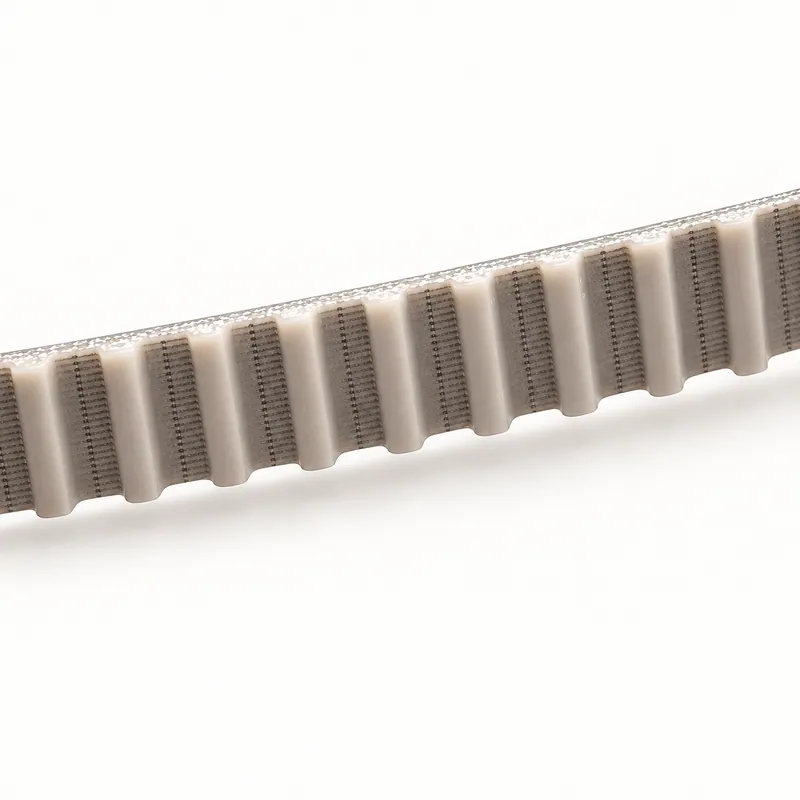

SKF PHG AT5-1125-S150 polyurethane belt
- Brand
- SKF
- Category
- Power transmission
- Subcategory
- Polyurethane belts
We respond promptly.
Since 1945 · Martínez, Buenos Aires, Argentina
Request your quote via WhatsApp or email, with the quantity you need.
Can't find the exact model? Write to us with the part number or model you're looking for: we'll find it and quote it, even if it's not listed in the catalog.
Description
SKF PHG AT5-1125-S150 is a reference of polyurethane belt, within Power transmission. Request a quote for PHG AT5-1125-S150 via WhatsApp or email with the quantity you need; we respond promptly with the quote and equivalents.
SKF PHG line polyurethane belts with AT profile are power transmission components for applications requiring precision and synchronism. Their polyurethane body, internally reinforced, gives them good abrasion and wear resistance, and the AT profile with the pitch indicated in the part number allows transmitting motion without slipping in equipment where positioning accuracy is key. MR Accesorios Industriales sells them in Buenos Aires, Argentina, and advises you to choose the correct size for your equipment.
The designation of these belts is read in blocks. PHG identifies the polyurethane line; AT indicates the toothed profile, and the number that follows —for example, 5 or 10— is the pitch in millimeters. Then comes the length in millimeters and the suffix S150, which corresponds to the belt width. Thus, a part number such as PHG AT10-1000-S150 is interpreted as AT10 profile, 10 mm pitch, 1000 mm length and S150 width. The series examples also include sizes such as PHG AT5-255-S150 and PHG AT10-1860-S150.
These belts are used in industries in Argentina where movements need to be synchronized: feeding of packaging lines, positioning in machine tools, internal transport of parts, driving of pumps and fans, and printing equipment. They also appear in the food and pharmaceutical sector, where polyurethane withstands cleaning well and does not shed particles. Since they do not stretch like a flat belt, they maintain the transmission ratio and avoid frequent adjustments.
To select the correct belt, take into account the profile and pitch required by the pulley, the length according to the center distance and the width according to the power to be transmitted. Polyurethane withstands moderate temperatures and does not need lubrication, but it is advisable to verify pulley alignment and adequate tension: a belt that is too tight accelerates bearing wear, and a loose one can jump teeth. Also check that there are no sharp edges or debris that could damage the teeth.
As for equivalents, polyurethane belts with AT profile are available from different brands under similar nomenclatures, but the pitch, width and type of reinforcement do not always match. Therefore, before replacing one belt with another from a different manufacturer, compare the complete designation and the actual dimensions. If you have doubts, send us the part number stamped on the belt and the pulley dimensions: at MR Accesorios Industriales we help you identify the right option.
To request a quote, write to us by WhatsApp with the complete part number of the belt (for example, PHG AT10-1480-S150) or with the pitch, length and width dimensions. With those data we can confirm the reference and give you a quick answer. MR Accesorios Industriales sells brands such as SKF in Buenos Aires, Argentina.
Dimensions
- Profile
- AT5
- Pitch
- 5mm
Frequently Asked Questions
- How do I know which PHG AT belt I need?
- Look at the part number stamped on the old belt: it shows the profile, pitch, length and width. If you don't have it, measure the pitch between teeth, the total length and the width. With those data we quote you the exact reference.
- Do polyurethane belts need lubrication?
- No, polyurethane runs dry. Just keep the pulleys clean and verify tension and alignment. Avoid contact with aggressive oils or solvents that could degrade the material.
- Can I replace an AT10 belt with another brand?
- Yes, as long as the profile, pitch, length and width match. Do not rely only on the part number: compare the actual dimensions. If you are unsure, send us the data and we will advise you.