
Product page
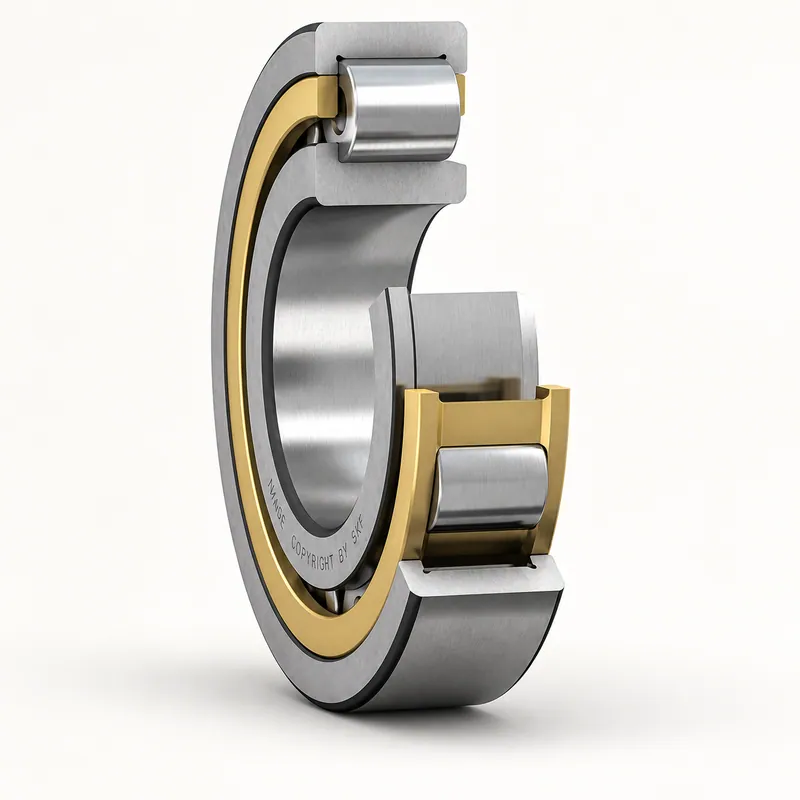
Cylindrical roller bearing SKF NJ 2305 ECML/C3
- Manufacturer Part Number
- NJ 2305 ECML/C3
- Brand
- SKFOfficial brand
- Category
- Bearings
- Subcategory
- Cylindrical roller bearings
Other brands in this category
- FAG
- NTN
- TIMKEN
Ask us about alternatives. Equivalence is verified for each reference and application.

We respond promptly.
Request your quote via WhatsApp or email, with the quantity and time frame you need.
Can't find the exact model? Write to us with the part number or model you're looking for: we'll find it and quote it, even if it's not listed in the catalog.
Description
SKF NJ 2305 ECML/C3 is a cylindrical roller bearing reference, within Bearings. Request a quote for NJ 2305 ECML/C3 via WhatsApp or email with the quantity you need; we respond promptly with lead time and equivalents.
The SKF NJ series cylindrical roller bearing is a component with high radial load capacity, designed to withstand heavy loads and considerable speeds. Its design with two ribs on the inner ring and one on the outer ring allows axial guidance in one direction, making it suitable for applications requiring precise axial location. It is used in industrial machinery, gearboxes, pumps and power transmission equipment.
The designation NJ … ECML/C… is interpreted as follows: NJ indicates that the inner ring has two ribs and the outer ring one, allowing axial guidance in one direction. The number that follows is the size code according to the dimension series. EC means machined brass window cage, ML indicates machined brass cage guided by the inner ring, and C… specifies the internal radial clearance, for example C3 or C4. Examples: NJ 219 ECML/C3, NJ 230 ECML/C3, NJ 316 ECML/C4.
These bearings are used in industries such as steel, cement, mining, paper and machinery manufacturing. In Argentina, they are common in speed reducers, gearboxes, centrifugal pumps, industrial fans and transmission equipment. Their ability to withstand high radial loads and their rigidity make them suitable for applications with high mechanical demands.
To select correctly, consider the radial and axial load, the rotational speed and the environmental conditions. The internal clearance C3 or C4 is suitable when thermal expansion or interference fits are expected. Lubrication must be chosen according to temperature and speed; for high speeds, oil is recommended. It is essential to ensure precise alignment between shaft and housing, and to verify sealing to prevent contamination.
Regarding equivalences, SKF NJ series bearings can be interchanged with those of other brands that follow the same dimensional and suffix designation, such as FAG, NSK or NTN, as long as the specified tolerances and clearance are respected. It is important to verify the complete code and operating conditions before replacing one bearing with another from a different manufacturer.
For a specific application, it is best to consult our specialists. At MR Accesorios Industriales we advise you to choose the right bearing. Send us the code via WhatsApp and we will quote you promptly.
This description provides guidance on the product type. Check the configuration and dimensions of this reference.
Dimensions
Dimensions and tolerances: Send us the part number via WhatsApp and we'll confirm dimensions, sealing, and internal clearance against the manufacturer's data sheet.
Frequently Asked Questions
- What does the ECML suffix mean on an SKF NJ bearing?
- EC indicates a machined brass window cage, and ML that it is guided by the inner ring. This combination is common in cylindrical roller bearings for demanding applications.
- When should a C3 or C4 clearance be used?
- C3 or C4 clearance is recommended when there are interference fits, thermal expansion or high speeds, as it allows dimensional variations to be compensated without compromising operation.
- Can I replace an SKF NJ bearing with one from another brand?
- Yes, as long as the dimensional designation and suffixes match. Brands such as FAG, NSK or NTN offer equivalents, but verify tolerances and clearance before interchanging.