
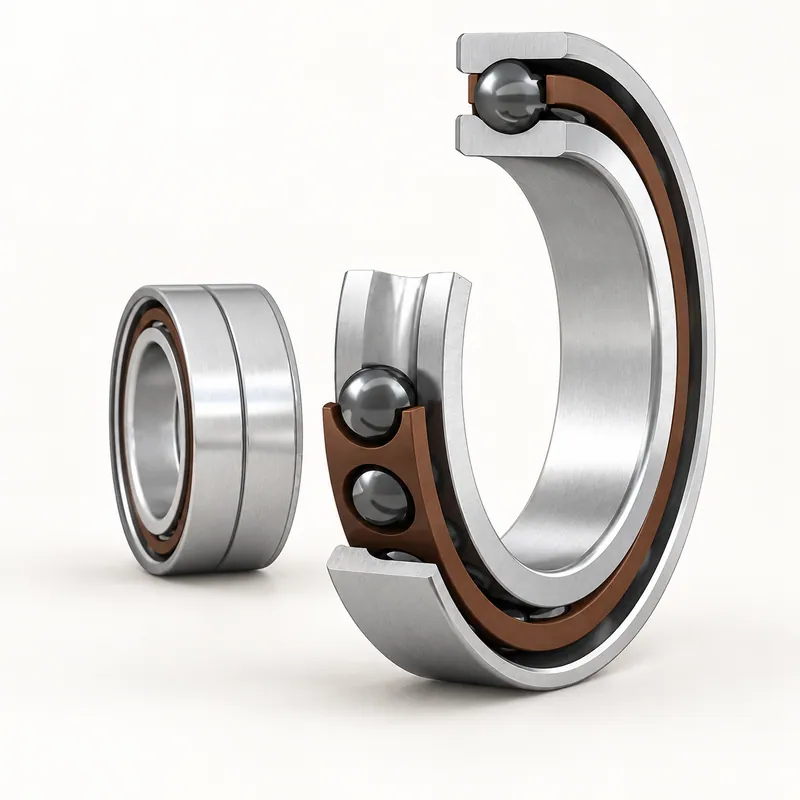

SKF 7009 ACD/P4ATGB angular contact ball bearing
- Brand
- SKF
- Category
- Bearings
- Subcategory
- Angular contact ball bearings
We respond promptly.
Since 1945 · Martínez, Buenos Aires, Argentina
Request your quote via WhatsApp or email, with the quantity you need.
Other brands in this category
Ask us about alternatives. Equivalence is verified for each reference and application.
Can't find the exact model? Write to us with the part number or model you're looking for: we'll find it and quote it, even if it's not listed in the catalog.
How to read SKF 7009 ACD/P4ATGB
- 70Series
- Angular contact ball bearings, 70 series. For the same bore, each series has a different outside diameter and width.
- 09Bore
- 45 mm bore: 09 × 5.
- ACD/P4ATGBSuffix
- SKF suffix: it defines the variant (sealing, cage, internal clearance or other features).
7009 is the standard (ISO) basic designation: it defines the type, the series and the bore.
Description
SKF 7009 ACD/P4ATGB is a reference of angular contact ball bearing, within Bearings. Request a quote for 7009 ACD/P4ATGB via WhatsApp or email with the quantity you need; we respond promptly with the quote and equivalents.
SKF angular contact bearings are components designed to withstand simultaneous radial and axial loads. Their design with oblique contact raceways allows superior performance in applications requiring high precision and rigidity. At MR Accesorios Industriales we carry this line to meet the demands of Argentine industry.
The designation ACD/P…ATGB is interpreted as follows: ACD indicates an optimized contact angle and a high-strength polyamide cage, while P… specifies the precision class (for example, P4 for high precision). The suffix ATGB indicates reduced axial clearance and a universal arrangement for tandem, face-to-face or back-to-back mounting. The examples 7009 ACD/P4ATGB and 7206 ACD/P4ATGB show series with bore diameter 10 and 20 respectively, with performance for severe demands.
These bearings are used in machine tool spindles, high-pressure pumps, compressors, electric motors and power transmission equipment. In Argentina, they are common in the automotive, metalworking, food and petrochemical industries, where the combination of loads and the need for precision are critical. Their ability to run at high speeds makes them suitable for dynamic applications.
To select the right bearing, consider the magnitude and direction of the loads, the rotation speed and the environmental conditions. Mounting requires precise alignment and adequate lubrication, whether grease or oil, depending on the operating regime. Sealing can be open or with protective plates; in contaminated environments, choose variants with seals. Axial clearance must be adjusted according to the application to avoid overloads.
Regarding equivalents, SKF angular contact bearings can be interchanged with those from other brands that follow the same ISO designation, such as FAG, NSK or NTN, as long as dimensions and tolerances match. It is essential to verify the contact angle and precision class to ensure compatibility. Ask us about equivalent alternatives.
To receive an accurate quote, send the complete bearing part number you need via WhatsApp to MR Accesorios Industriales. Our technical team will advise you on the best option for your application.
Dimensions
- Bore
- 45mm
Frequently Asked Questions
- What does the ACD suffix mean on an SKF bearing?
- ACD indicates a design with an optimized contact angle and a high-strength polyamide cage, which improves axial load capacity and limiting speed. It is common in high-precision applications.
- How do I choose between tandem, face-to-face or back-to-back mounting?
- The choice depends on the required rigidity and clearance. Tandem mounting supports axial loads in one direction, while face-to-face or back-to-back arrangements handle loads in both directions and offer greater rigidity.
- What lubrication do you recommend for these bearings?
- High-quality grease is recommended for general applications and oil for high speeds or elevated temperatures. The final choice depends on the operating conditions and the type of sealing.