
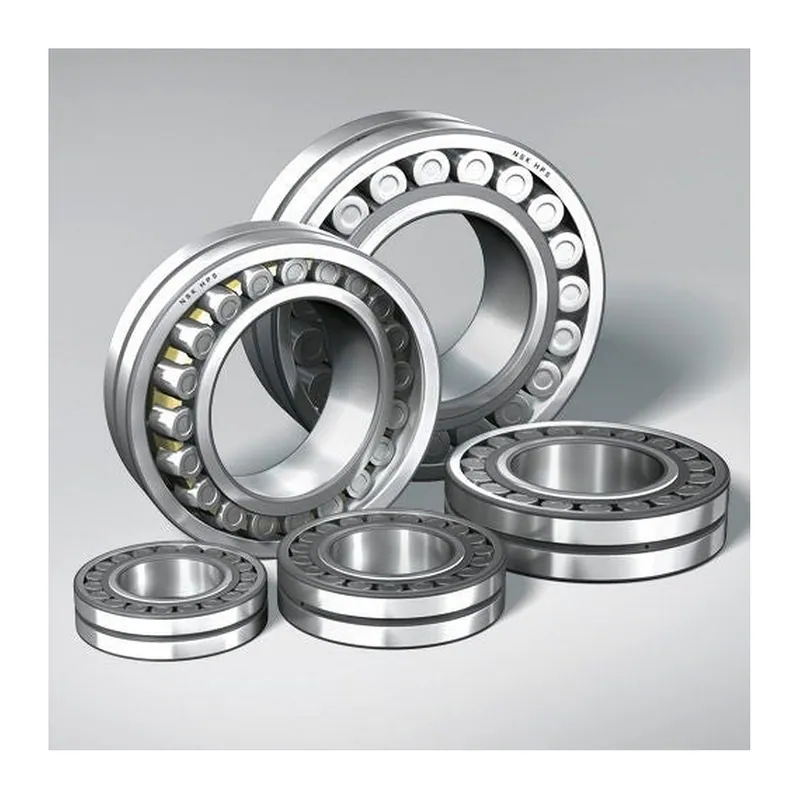

NSK 22217EAKE4 spherical roller bearing
- Brand
- NSK
- Category
- Bearings
- Subcategory
- Spherical roller bearings
We respond promptly.
Since 1945 · Martínez, Buenos Aires, Argentina
Request your quote via WhatsApp or email, with the quantity you need.
Can't find the exact model? Write to us with the part number or model you're looking for: we'll find it and quote it, even if it's not listed in the catalog.
How to read NSK 22217EAKE4
- 222Series
- Spherical roller bearings, 222 series. For the same bore, each series has a different outside diameter and width.
- 17Bore
- 85 mm bore: 17 × 5.
- EAKE4Suffix
- NSK suffix: it defines the variant (sealing, cage, internal clearance or other features).
22217 is the standard (ISO) basic designation: it defines the type, the series and the bore.
Description
The NSK 22217EAKE4 bearing has a 85 mm bore, a 150 mm outside diameter and a 36 mm width (85 x 150 x 36 mm).
NSK 22217EAKE4 is a reference of spherical roller bearing, within Bearings. Request a quote for 22217EAKE4 via WhatsApp or email with the quantity you need; we respond promptly with the quote and equivalents.
The NSK spherical roller bearing is a component designed to withstand high radial loads and axial loads in both directions, with self-aligning capability. Its design with two rows of rollers and a spherical outer raceway allows it to compensate for angular misalignment between shaft and housing, which reduces precision requirements during assembly. It is used in applications where there is shaft deflection or differential settling, such as industrial transmissions, mining, cement and material handling equipment. MR Accesorios Industriales sells this line in Buenos Aires, Argentina.
The EAKE series designation is interpreted as follows: the numeric prefix indicates the size, the letters EA correspond to a roller and cage design optimized for greater load capacity, K indicates the tapered bore (1:12 taper), and E identifies internal execution variants. The examples show how the base code changes with diameter; the suffix 4 indicates an NSK-specific modification. Understanding this reading allows you to order the correct replacement without ambiguity.
In Argentine industry, these bearings appear in conveyor belts, mills, crushers, vibrating screens, speed reducers and process equipment in cement, mining, steel and food plants. They are also found in large agricultural machinery and industrial fans. Their ability to work with misalignment makes them suitable for long shafts or shafts mounted on structures that deflect under load, where a rigid bearing would require very precise alignments that are costly to maintain.
To select correctly, take into account the radial and axial load, the rotation speed and the type of lubrication. The tapered bore with suffix K is mounted on an adapter sleeve or directly on a tapered shaft; in both cases, verify the internal clearance after adjustment. Sealing can be open, with shields or with seals, depending on the environment: in the presence of dust or moisture, choose sealed variants. Grease or oil lubrication must follow the manufacturer's recommendation and be renewed according to service hours.
When looking for cross-references with other brands, spherical roller bearings are identified by their numeric designation and suffixes that indicate taper, cage and execution. Not all suffixes are interchangeable between manufacturers, so it is advisable to verify main dimensions and internal clearance before replacing. If you have the part number from another brand, we can guide you on the equivalent NSK reference. Dimensional interchangeability is usually possible, but load capacities and limiting speeds may vary.
To get a quote for the NSK spherical roller bearing you need, send us the full part number on WhatsApp. If you don't have it at hand, send us the main dimensions or a photo of the part and we'll help you identify it. At MR Accesorios Industriales we handle inquiries from all over the country and reply shortly with the reference that corresponds to your equipment.
Dimensions
Boundary dimensions of the basic designation 22217 per ISO 15: 85 x 150 x 36 mm (d x D x B).
- Bore
- 85 mm
- Outside diameter (D)
- 150mm
- Width (B)
- 36mm
Same size in SKF and other brands
Pages from other brands with the basic designation 22217: 85 x 150 x 36 mm (d x D x B) per ISO 15.
- Looking for the SKF 22217? We also quote:22217 E22217 EK22217 E/C39 more →
- FAG22217-E1-XL22217-E1-XL-K
- LINK-BELT22217LB22217LBK22217LBC31 more →
- NTN22217EAD122217EMD122217EAKD11 more →
- RKB22217
- TIMKEN22217EJ22217EM
They share the boundary dimensions set by ISO 15, not the technical data: seals or shields, internal clearance, cage and load rating can differ by brand and suffix. We quote each one by its full part number.
Frequently Asked Questions
- What are the dimensions of the NSK 22217EAKE4 bearing?
- The NSK 22217EAKE4 bearing has a 85 mm bore, a 150 mm outside diameter and a 36 mm width (85 x 150 x 36 mm). These are the standardised boundary dimensions (ISO 15) of the basic designation 22217.
- What does the K suffix mean in a spherical roller bearing?
- The letter K indicates that the bearing has a tapered bore with 1:12 taper. This allows it to be mounted on an adapter sleeve or directly on a tapered shaft, which facilitates adjustment of internal clearance and disassembly. It is a common option in applications where manufacturing tolerances need to be compensated.
- How do I choose between an open and a sealed bearing?
- It depends on the working environment. If there is dust, moisture or particles, a sealed bearing is advisable to protect the lubricant and prevent contamination. In clean environments with oil lubrication, an open one can be used. Permissible speed also matters: seals generate more friction and limit rpm.
- Can I replace a bearing from another brand with an NSK one?
- Generally yes, if the main dimensions and execution type match. Suffixes may vary between manufacturers, so it is important to verify taper, cage and internal clearance. If you send us the original brand's part number, we'll tell you the equivalent NSK reference and the technical differences to consider.