
Product page
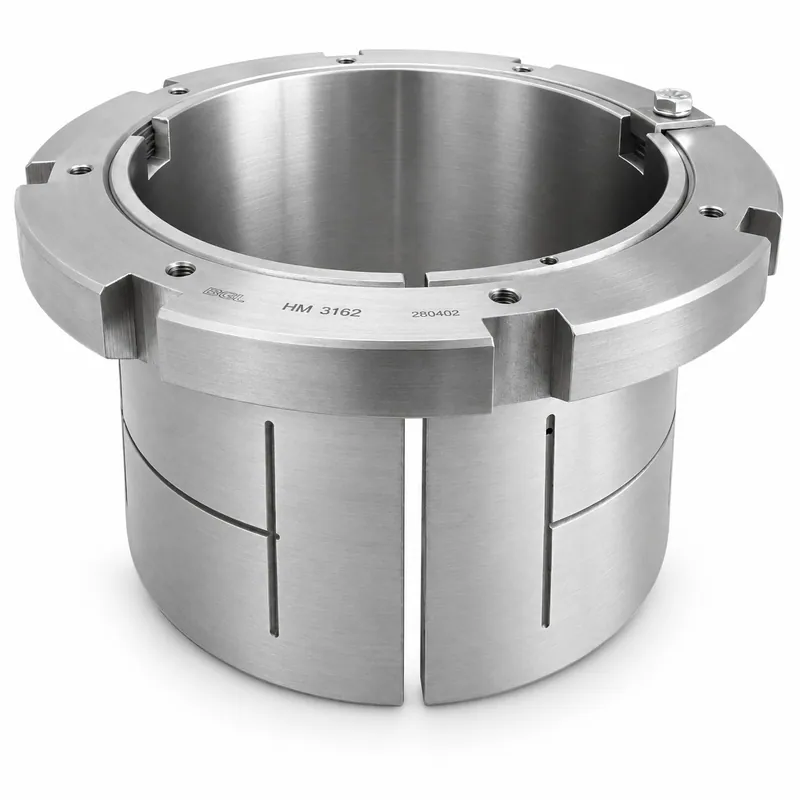
Hydraulic sleeve BGL OH3152HTL
- Manufacturer Part Number
- OH3152HTL
- Brand
- BGLExclusive representative in Argentina
- Category
- Bushings and sleeves
- Subcategory
- Hydraulic sleeve

We respond promptly.
Request your quote via WhatsApp or email, with the quantity and time frame you need.
Can't find the exact model? Write to us with the part number or model you're looking for: we'll find it and quote it, even if it's not listed in the catalog.
Description
BGL OH3152HTL is a hydraulic sleeve reference, within Bushings and sleeves. Request a quote for OH3152HTL via WhatsApp or email with the quantity you need; we respond promptly with lead time and equivalents.
The BGL OH...HTL hydraulic sleeve is a fastening component with internal and external oil channels for injecting oil under pressure. This facilitates mounting and, above all, dismounting on medium and large diameter shafts. It is used to secure bearings, pulleys, couplings and other elements on shafts, especially in applications where frequent disassembly or precise fitting is critical. MR Accesorios Industriales sells this line as exclusive representative in Argentina.
The OH...HTL designation is interpreted as follows: the letters OH identify the hydraulic adapter sleeve series; the number that follows, as in OH31/950HTL or OH3144HTL, indicates the size and nominal shaft diameter for which it is intended. The HTL suffix indicates the configuration with an oil channel on the outer side, which allows oil injection to facilitate mounting and dismounting. Examples OH31/1000HTL, OH31/1060HTL, OH3148HTL, OH3152HTL, OH3156HTL and OH3160HTL show the variety of sizes available in this series.
These sleeves are used in industries such as steel, cement, mining, paper and power generation, where large diameter shafts require mounting methods that reduce the risk of damage and allow clean dismounting. They also appear in grinding equipment, rotary kilns, conveyor belts and large machines. In Argentina, they are common in plants that need to maintain large bearings with periodic interventions.
To select the correct sleeve, take into account the shaft diameter and the dimensions of the bearing or component to be fastened. Lubrication with oil under pressure is key: it is injected through the channels to create a film that reduces friction during mounting and dismounting. It is essential to correctly align the assembly and follow the manufacturer's recommended procedure to avoid deformation. Sealing and cleanliness of the surfaces also influence the result.
Regarding equivalences, hydraulic sleeves from different manufacturers can be interchanged if the main dimensions and the type of oil channel match. It is always advisable to verify the complete designation and measurements before replacing a part. If you have the code from another brand, we can help you find the equivalent BGL reference.
To request a quote for the BGL OH...HTL hydraulic sleeve you need, write to us via WhatsApp with the code or exact size. At MR Accesorios Industriales we will respond promptly.
This description provides guidance on the product type. Check the configuration and dimensions of this reference.
Dimensions
Dimensions and tolerances: Send us the part number via WhatsApp and we'll confirm dimensions, sealing, and internal clearance against the manufacturer's data sheet.
Frequently Asked Questions
- What is the difference between a hydraulic sleeve and a standard adapter sleeve?
- The hydraulic sleeve has internal and external channels that allow oil to be injected under pressure. This facilitates mounting and especially dismounting, which is key on large shafts where the fit is very tight. The standard adapter sleeve does not have these channels.
- For what shaft diameters is the BGL OH...HTL sleeve recommended?
- It is designed for medium and large shafts, from 140 mm and up. The series covers different sizes; ask us about the one you need and we will quote it.
- How are mounting and dismounting carried out with oil under pressure?
- Oil is injected through the sleeve channels to create a lubricating film that reduces friction. Then the component is positioned and the pressure is released. For dismounting, the procedure is repeated, which prevents damage to the shaft and the bearing.