
Blog
Tsubaki in agriculture: components for harvesters, seeders, bucket elevators and storage plants
Which Tsubaki parts are used in agricultural machinery and storage plants, how to identify them and what data to send to get a quote.
TSUBAKI catalog by part number
Technical team at MR Accesorios Industriales · Updated on November 7, 2026
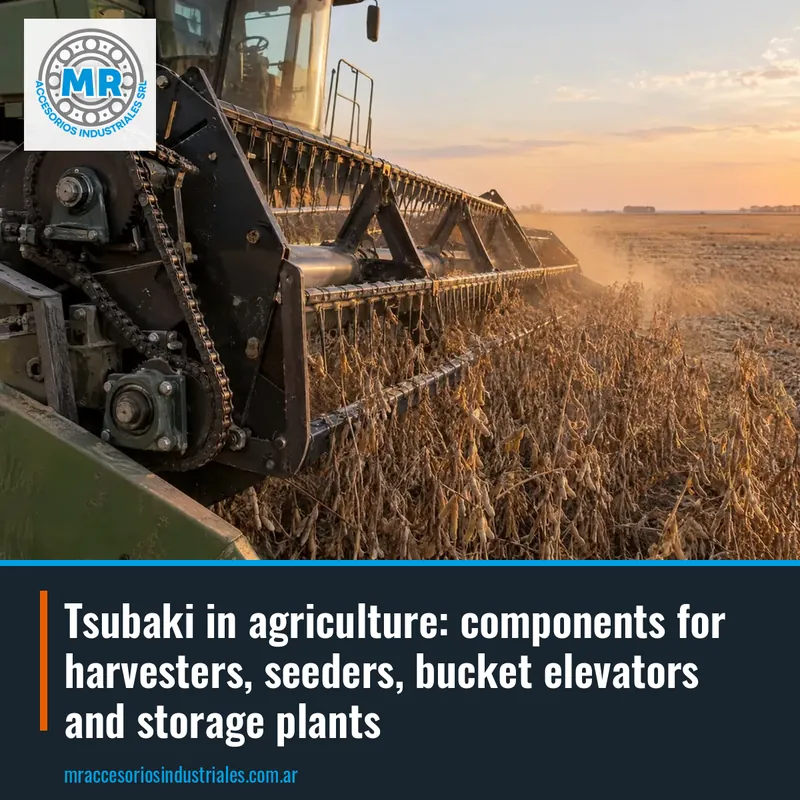
Tsubaki roller chains for power transmission in agriculture
Tsubaki roller chains are a key component in power transmission for harvesters, seeders and other agricultural equipment. They transmit motion between shafts with a constant speed ratio, even under variable load conditions. In agriculture, they are found in header drives, augers, grain elevators and auxiliary traction systems. Their standardized design allows simple replacements based on the chain pitch and inner width.
To identify a roller chain on a machine, measure the pitch (distance between centers of two consecutive pins) and the inner width between plates. With these data you can determine the corresponding series, such as RS40 or RS60, which are common in agricultural equipment. It is also useful to check whether the chain has any surface treatment or special seal, since in environments with dust and harvest residue, versions with retainers are recommended. At MR we sell Tsubaki roller chains such as RS40 and RS60, among others.
A common mistake when replacing chains in agriculture is choosing only by length and not verifying the pitch. A chain with the wrong pitch can damage the sprockets and generate vibrations. Another point to consider is lubrication: in agricultural applications with a lot of dirt, use lubricants that do not retain abrasive particles. To get a quote, send us the code engraved on the links, the pitch measurement and the number of links needed.
Tsubaki freewheels for auger and bucket elevator drives
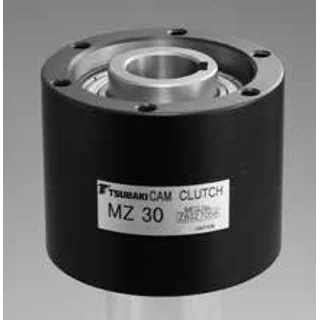
Tsubaki freewheels allow a shaft to rotate freely in one direction and lock in the opposite direction. In agriculture they are used in unloading auger drives, grain bucket elevators and quick-reverse systems on seeders. Their main function is to prevent load backflow or allow free rotation when the equipment stops. These parts are mounted directly on the shaft or inside a housing, depending on the equipment design.
To identify a freewheel, measure the shaft diameter where it is mounted and the width of the inner race. It is also important to know the free rotation direction and the locking direction, which is usually indicated with an arrow on the housing. At MR we distribute Tsubaki freewheels such as MZ15, MZ30 and MZ70, which cover different shaft diameters and load capacities. If you cannot find the engraved code, a photo of the part and the shaft measurements are enough to start the search.
A common mistake when installing a freewheel is reversing the rotation direction, which can lock the mechanism and cause breakage. Another point to check is axial fixation: the freewheel must be well secured to prevent displacement that wears the shaft. In applications with frequent starts and stops, check the internal clearance and the condition of the locking elements. To get a quote, indicate the part code or the shaft measurements and total width.
Tsubaki conveyor chains for elevators and storage
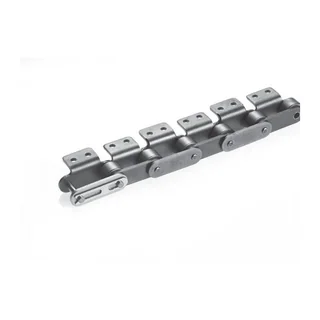
Tsubaki conveyor chains are designed to move bulk materials such as grains, seeds and fertilizers. They differ from roller chains by their taller side plates and reinforced pins, which allow them to withstand high tensile loads. In storage plants they are used in bucket elevators, drag conveyors and distribution systems. Their maintenance is critical to avoid plant downtime during harvest.
To identify a conveyor chain, measure the pitch, the inner width and the plate height. It is also useful to know the type of bucket or attachment mounted on the chain, since that defines the fixing pattern. At MR we sell Tsubaki conveyor chains such as M 20, M 40 and M 56. If the chain is very worn, also check the sprockets and guide rails.
A frequent mistake in storage plants is stretching the chain's service life beyond the allowable wear, which can cause breakage and damage to the elevator. Another point to consider is tension: a loose chain can jump off the sprockets, while a very tight one increases wear. To get a quote, send us the chain code, the pitch and the number of meters or links needed.
Tsubaki leaf chains for low-speed drives
Tsubaki leaf chains are used in low-speed, high-load applications such as platform drives, gates and lifting mechanisms in agricultural machinery. Unlike roller chains, they do not have rotating rollers, but flat plates that articulate on pins. This makes them more robust for static loads or intermittent movements. In agriculture, they appear in adjustment and lifting mechanisms.
To identify a leaf chain, measure the pitch, the plate width and the pin diameter. It is also important to know the number of plates per link, since single and multiple configurations exist. At MR we distribute Tsubaki leaf chains such as BL 466, BL 646 and BL 844, which cover different load capacities. If the chain is broken, measure a section of several links to confirm the pitch.
A common mistake when replacing leaf chains is using one with lower load capacity, which can cause premature breakage. Another point to check is sprocket alignment, since misalignment generates lateral loads that wear the plates. To get a quote, indicate the chain code or the pitch, width and pin diameter measurements.
Tsubaki couplings for connecting shafts in agricultural equipment
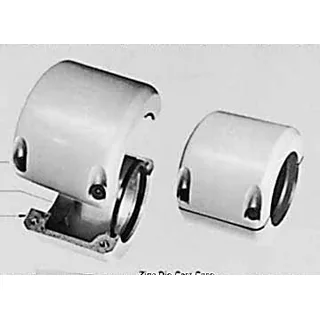
Tsubaki couplings are used to connect two shafts and transmit power between them, compensating for small misalignments. In agriculture, they are found in pumps, augers, mixers and other equipment where the motor and load are separate. There are different types, such as chain couplings, gear couplings and elastic couplings, each with vibration absorption characteristics and misalignment capacity. The choice depends on the torque to be transmitted and the mounting conditions.
To identify a coupling, measure the diameter of the shafts it connects, the distance between shaft ends and the outer diameter of the coupling. It is also useful to know the type of flexible or transmission element it uses. At MR we sell Tsubaki couplings such as CR3812, CR5014 and CR5016. If the coupling is damaged, also check the condition of the shafts and keyways.
A frequent mistake when installing a coupling is forcing shaft alignment, which generates radial loads that reduce the service life of the coupling and bearings. Another point to consider is lubrication of the internal components, especially in chain or gear couplings. To get a quote, send us the coupling code or the shaft measurements and the distance between them.
Tsubaki torque limiters to protect agricultural equipment
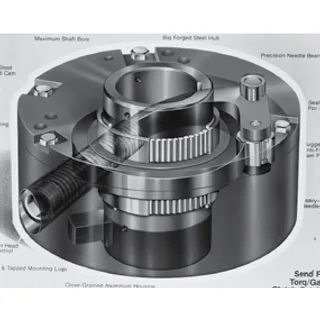
Tsubaki torque limiters protect agricultural machinery against sudden overloads, such as jams in augers or impacts on headers. They work by disconnecting the transmission when torque exceeds a preset value, preventing damage to chains, gears and motors. In agriculture, they are used in harvesters, choppers and tillage equipment. Their adjustment must be made according to the equipment manufacturer's specifications.
To identify a torque limiter, you need to know the required disengagement torque and the mounting dimensions, such as shaft diameter and fixing pattern. It is also important to know whether the limiter is friction, ball or another type, since each has a different behavior. At MR we distribute Tsubaki torque limiters, and if you do not have the code, with the measurements and working torque we can identify the model.
A common mistake is adjusting the torque limiter to a higher value than recommended to avoid frequent disconnections, which cancels its protective function. Another point to check is wear of the friction elements, which can alter the disengagement torque. To get a quote, indicate the limiter code or the shaft measurements and the desired disengagement torque.
How to get a quote for Tsubaki components for agriculture
To get a quote for any Tsubaki component for agriculture, the most practical way is to send us the code engraved on the part, if visible. On chains, the code is usually on the side plates; on freewheels and couplings, on the housing or hub. If the code is erased, with the main measurements (pitch, width, shaft diameter) we can identify the part. A photo of the part and the place where it is mounted also helps.
At MR we sell Tsubaki components for agricultural machinery and storage plants: roller chains, conveyor chains, leaf chains, freewheels, couplings and torque limiters. If you have a part from another brand and want a Tsubaki equivalent, send us the code and measurements, and we will indicate the alternative.
You can get a quote via WhatsApp or email by sending the code, measurements or a photo of the part. We will reply as soon as possible. We are in Buenos Aires, Argentina.
Frequently asked questions
How do I identify a Tsubaki chain for a harvester?
Measure the pitch (distance between centers of two consecutive pins) and the inner width between plates. With these data you can determine the series, such as RS40 or RS60. If the chain has an engraved code, send us a photo and we will confirm the model.
Which Tsubaki freewheel does an unloading auger use?
It depends on the shaft diameter and rotation direction. Tsubaki freewheels such as MZ15, MZ30 or MZ70 cover different diameters. Measure the shaft and check the free rotation arrow on the housing, and with that we will quote the correct one.
How do I request a conveyor chain for a grain elevator?
We need the pitch, the inner width and the plate height. If the chain has a code, such as M 20, M 40 or M 56, send us that data. Also indicate the number of meters or links you need.
Which Tsubaki coupling do I use to connect a motor to an auger?
It depends on the shaft diameter and the torque to be transmitted. Models such as CR3812, CR5014 or CR5016 are common in agricultural applications. Measure the shafts and the distance between them, and we will indicate the appropriate coupling.
How do I get a quote for a Tsubaki torque limiter for a chopper?
We need the required disengagement torque and the mounting dimensions (shaft diameter, fixing pattern). If you have the limiter code, even better. With these data we will quote the correct model.
Products with photos in the catalogue
Keep reading
- Tsubaki industrial chains: quality, durability and performance for demanding applications
Discover the types of Tsubaki chains we supply: roller, conveyor, leaf, freewheels, couplings and torque limiters. We help you choose the right one for your application.
- How to Read Tsubaki Codes: Designation Structure, Prefixes, Suffixes, and Real Examples
Practical guide to interpreting the nomenclature of Tsubaki chains, freewheels, couplings, and other products. With real examples and tips for requesting quotes.
- Tsubaki by industry: where it is used, how to select it, assembly and maintenance to make it last
We review the most common Tsubaki applications in Argentine industry, selection criteria according to component type, and good assembly and maintenance practices to extend service life.
Continue here
Need a TSUBAKI quote?
Send us the TSUBAKI part number, the size or a photo of the part and we will get back to you with a quote.