
Blog
ThyssenKrupp / Rothe Erde dimensions: how to identify the code from the part and what data to send for a quote
We explain how to read the dimensions and markings on a ThyssenKrupp / Rothe Erde slewing ring to identify the exact code, and what information to send us to quote the replacement.
ThyssenKrupp / Rothe Erde catalog by part number
Technical team at MR Accesorios Industriales · Updated on November 19, 2026
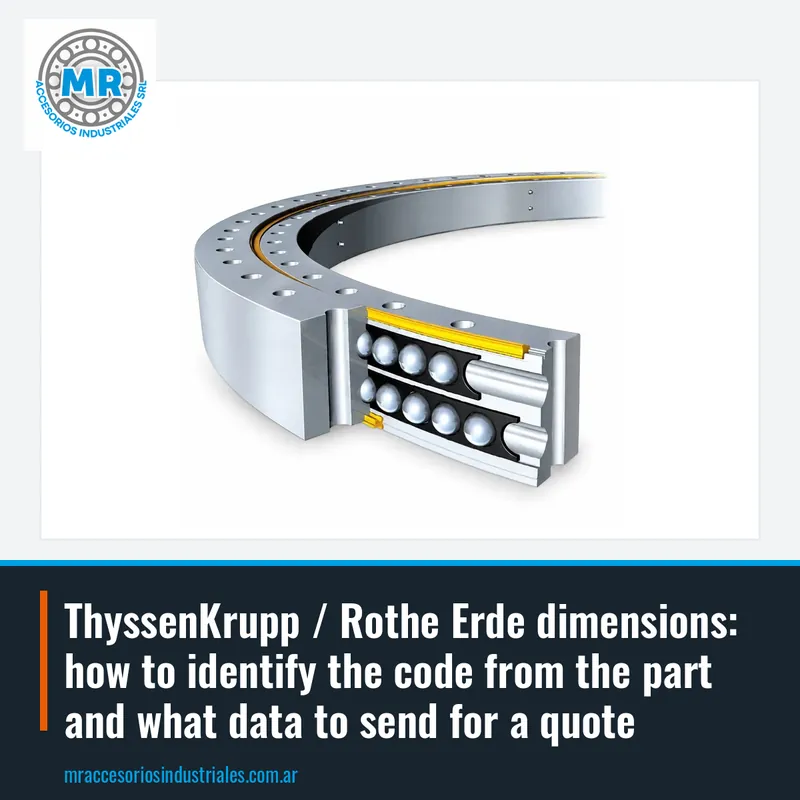
What a ThyssenKrupp / Rothe Erde slewing ring is and what it is used for
ThyssenKrupp / Rothe Erde slewing rings are large-diameter bearings that allow rotational movement between two structures. They are used in equipment where one part has to rotate relative to another while supporting axial loads, radial loads and tilting moments at the same time. They are key components in cranes, excavators, wind turbines, aerial platforms and machine tools.
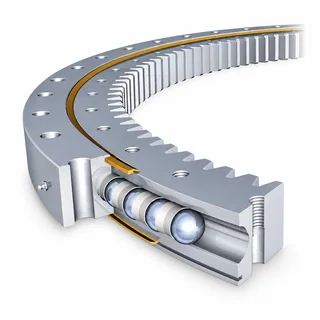
Unlike a conventional bearing, the slewing ring integrates the toothed ring, the rolling elements and the mounting holes in a single part. This simplifies assembly and reduces the space required. In Argentine industry they appear in port, mining and road equipment and in process plants where there are continuous or intermittent rotation movements.
When a slewing ring fails, the equipment is out of service, so it is best to identify it quickly to order the replacement. At MR we market and distribute ThyssenKrupp / Rothe Erde slewing rings for different applications. If you have the part at hand, you can take photos and send them to us so we can help you identify the code.
How to read the dimensions of a ThyssenKrupp / Rothe Erde slewing ring
The main dimensions of a slewing ring are the outer diameter, inner diameter, total height and diameter of the mounting hole circle. The module and number of teeth of the toothed ring also matter, if it has one. If the part has a nameplate, also note down what appears on it.
To measure the slewing ring accurately, use a caliper or steel tape measure. Take the outer diameter at two opposite points and the inner diameter in the same way. The height is measured with the slewing ring resting on a flat surface. If the ring has teeth, count the number of teeth and measure the pitch diameter if possible.
With those dimensions you can start looking for the code. Check the edge and the faces of the part in case there is an engraved code. If you can't find it, the dimensions allow us to narrow the search in the catalog. At MR we help you identify the slewing ring from the dimensions and photos you send us.
How to identify the code from the part
The code of a ThyssenKrupp / Rothe Erde slewing ring is usually made up of several groups of numbers separated by dots, such as 060.20.0744.575.01.1403. The code may be engraved on the ring or appear on a label or nameplate.
If the label has come off or the engraving is blurred, the main dimensions and photos of the part serve to narrow the search and arrive at the code. It is advisable to note down any number or letter that can be read, even partially.
At MR we work with ThyssenKrupp / Rothe Erde slewing rings and can help you interpret the code. Send us a photo of the part showing the engraving or label, and the main dimensions. With that we confirm the exact code and quote it for you.
What data to send to quote a slewing ring
To quote a ThyssenKrupp / Rothe Erde slewing ring, it is advisable to send us the full code if you have it, such as 061.20.0644.575.01.1403. If you don't have it, send us the dimensions: outer diameter, inner diameter, height, hole circle diameter, number and diameter of holes, and tooth data if applicable.
A photo of the part from above and another from the side also help, showing the general condition and the teeth. If the slewing ring is mounted on equipment, tell us the equipment brand and model, and the mounting position. That helps us verify whether there are variants depending on the application.
With that data we quote the exact ThyssenKrupp / Rothe Erde slewing ring. Write to us by WhatsApp or email and we will reply promptly.
Common mistakes when ordering or mounting a slewing ring
A frequent mistake is ordering the slewing ring only by the outer diameter, without considering the inner diameter or the height. Two slewing rings with the same outer diameter can have a different raceway circle or number of holes. That leads to buying a part that does not fit or does not match the equipment.
Another mistake is not checking the type of teeth: internal, external or without teeth. The module and number of teeth must match the drive pinion. If they do not match, the gearing wears prematurely and can break the slewing ring or the pinion.
During mounting, the bolt tightening torque and the cross tightening sequence must be respected. Uneven fastening deforms the ring and reduces service life. Before dismounting, it is advisable to mark the relative position of the rings and take photos of the assembly, the teeth and the fastening area. Those images help confirm the part when the replacement arrives. If you have doubts about which slewing ring goes on your equipment, consult us before ordering. At MR we help you identify the correct part.
How to know if the slewing ring is damaged and needs replacement
The symptoms of a damaged slewing ring are excessive play between the rings, metallic noises when turning, vibrations or hard spots in the movement. There may also be grease loss or metal chips in the lubricant. If you notice any of these signs, it is advisable to inspect the slewing ring as soon as possible and note at what position of rotation the problem appears, because that data also helps when ordering the replacement.
To measure axial play, place a dial indicator on the outer ring and pry between the rings. Compare the value with the one indicated by the manufacturer for your equipment. Also check the condition of the teeth: chipped, stepped or unevenly worn teeth indicate failure.
In critical equipment, a slewing ring in poor condition can cause an accident. Therefore, when in doubt, it is advisable to replace it. At MR we market ThyssenKrupp / Rothe Erde slewing rings. Send us photos and dimensions, and we quote the replacement.
Why it is advisable to order the slewing ring with the correct code
A slewing ring must match the equipment in dimensions, hole circle and teeth. That is why the code is the most important data when ordering the replacement.
A part that does not correspond may not fit the equipment or may damage other components. Ordering the slewing ring with the correct code avoids those problems.
At MR we distribute ThyssenKrupp / Rothe Erde slewing rings. If you have the code or the dimensions, we quote the exact slewing ring. Write to us by WhatsApp or email with a photo of the part and we will reply promptly.
Frequently asked questions
How do I identify the code of a ThyssenKrupp / Rothe Erde slewing ring?
Look for the number engraved on the outer ring or on a label. It usually has the format 060.20.0744.575.01.1403. If it is not visible, measure the outer diameter, inner diameter, height and tooth data, and send us photos so we can help you.
What dimensions do I need to quote a ThyssenKrupp / Rothe Erde slewing ring?
Outer diameter, inner diameter, total height, hole circle diameter, number and diameter of holes, and tooth data (module and number of teeth). With that we quote the exact slewing ring.
Can I order a ThyssenKrupp / Rothe Erde slewing ring with only the outer diameter?
No, because there are slewing rings with the same outer diameter but different inner diameter, height or hole circle. It is always advisable to send all the dimensions or the full code to avoid errors.
What do I do if the label of the slewing ring has come off?
Send us the main dimensions and a photo of the part. At MR we help you identify the slewing ring from that data and quote the replacement.
How do I know if my ThyssenKrupp / Rothe Erde slewing ring is damaged?
If there is excessive play, noises when turning, vibrations, grease loss or metal chips, the slewing ring may be damaged. It is advisable to measure the axial play and check the teeth. When in doubt, consult us.
Products with photos in the catalogue
Keep reading
- How to identify and quote a ThyssenKrupp / Rothe Erde slewing ring
ThyssenKrupp / Rothe Erde slewing rings are large-diameter bearings for equipment that needs rotation and support of combined loads. We tell you how to identify and quote them.
- GUMMI Couplings: Vibration Absorption and Reliable Power Transmission for Industry
GUMMI elastic couplings absorb vibrations and misalignments, protect machinery, and ensure reliable power transmission. Learn about their configurations and how to choose the right model.
- Tsubaki industrial chains: quality, durability and performance for demanding applications
Discover the types of Tsubaki chains we supply: roller, conveyor, leaf, freewheels, couplings and torque limiters. We help you choose the right one for your application.
Continue here
Need a ThyssenKrupp / Rothe Erde quote?
Send us the ThyssenKrupp / Rothe Erde part number, the size or a photo of the part and we will get back to you with a quote.