
Blog
Slewing rings and modules for solar trackers: bearings and housings for your plant
Solar trackers rely on slewing rings and modules that withstand combined loads and slow movements. We explain which bearings and housings are used and how to get a quote.
Technical team at MR Accesorios Industriales · Updated on September 29, 2026
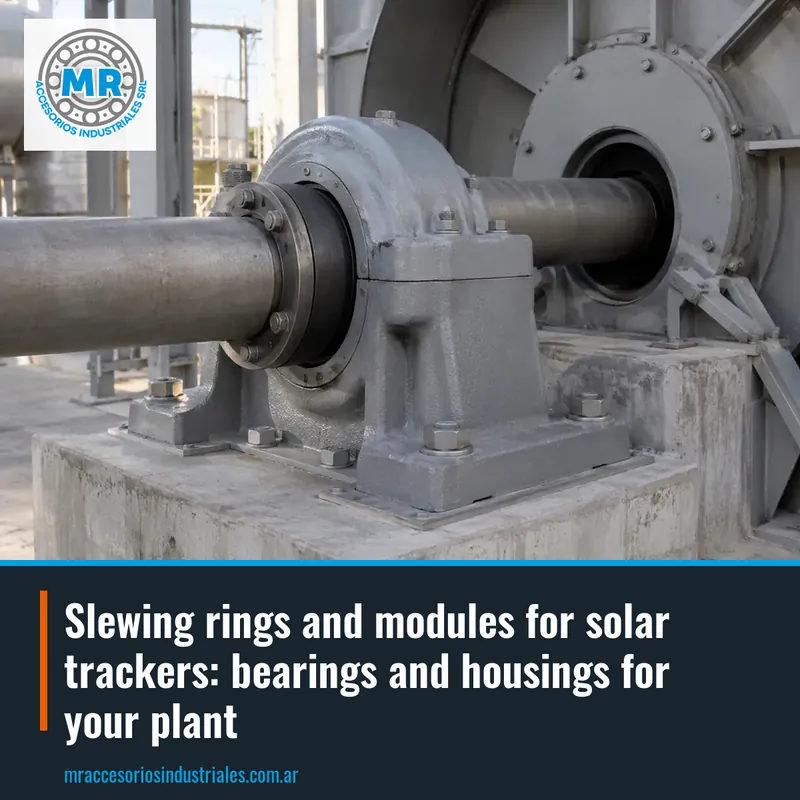
The role of slewing rings in solar trackers
Solar trackers are structures that orient photovoltaic panels toward the sun throughout the day to maximize energy capture. The rotation movement is achieved through a slewing ring or slewing module, which is a large-diameter bearing capable of withstanding axial, radial loads and tilting moments.
In solar energy applications, these slewing rings operate with slow, oscillating movements, often in outdoor conditions. That's why it's key to choose bearings with good load capacity, effective sealing and adequate lubrication to avoid premature failures.
At MR Accesorios Industriales we work with bearings and housings for this type of application. If you need to replace a slewing ring or associated components, we quote the options according to your technical requirement.
Spherical roller bearings for combined loads
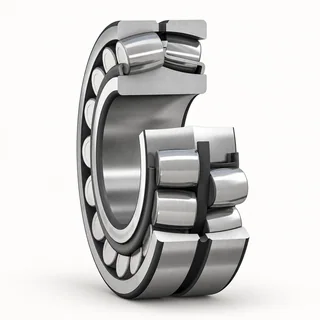
Spherical roller bearings are a frequent choice in solar trackers because they withstand combined radial and axial loads, and compensate for shaft misalignments. Their self-aligning design makes them robust against structural flexing or ground settling.
In our catalog we carry spherical roller bearings from brands such as SKF, FAG and LINK-BELT. For example, SKF codes 22325 and 22361, or FAG 20222-MB and 20240-MB, are references used in large-scale applications.
The SKF 223 series is widely used in slewing shaft housings due to its high load capacity. If your solar tracker has a central shaft with this type of bearing, we can quote the exact replacement.
Cylindrical and angular contact bearings in the slewing system
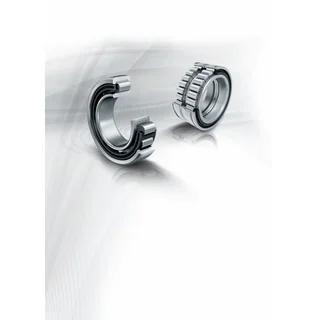
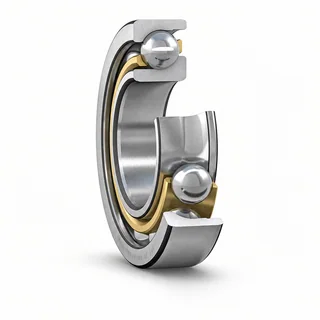
In addition to spherical roller bearings, cylindrical roller bearings are used in gearboxes or at support points where radial loads predominate. Meanwhile, angular contact bearings withstand combined loads and can be mounted in pairs to achieve greater rigidity.
At MR we work with cylindrical roller bearings such as SKF N3055 and RNU 305, or FAG SL182226 and SL183018. For angular contact, we offer references such as SKF 7417 and 7453, FAG 3314 and 3315, and TIMKEN 7310 B and 7211 B.
The choice between one and the other depends on the tracker design: if the movement is very slow with tilting loads, spherical roller bearings are usually the first option. If there are gearboxes, cylindrical and angular contact bearings appear on the intermediate shafts.
SNL split housings for tracker shafts
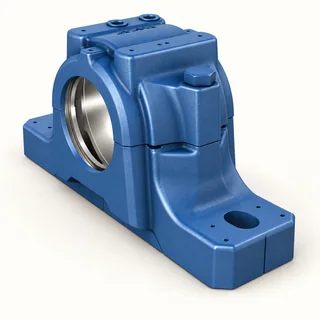
SNL split housings are split pedestals that facilitate the assembly and disassembly of bearings on horizontal shafts. In solar trackers, they are used to support the rotation shaft at various points along the panel row.
We carry SKF SNL housings, such as SNL 211 and SNL 216, which are combined with 62 or 22 series bearings depending on the shaft diameter. These housings allow faster maintenance because it's not necessary to disassemble the entire shaft to change the bearing.
If your solar plant uses this type of housing, it's important to verify the condition of the seals and lubrication. A poorly sealed housing lets in dust and moisture, which shortens the bearing's service life. We advise you on selecting the right housing and bearing.
Lubrication and maintenance in outdoor environments
Solar trackers operate outdoors, exposed to dust, rain, temperature changes and UV radiation. Lubrication is critical to protect bearings from corrosion and wear. High-quality greases with good adhesion and water resistance are recommended.
At MR we carry greases and lubricants for bearings in energy applications. We also offer assembly and maintenance tools, such as pullers, induction heaters and torque wrenches, to intervene in the field safely.
A preventive lubrication plan, with periodic regreasing according to operating hours, is the best way to avoid unscheduled downtime. If you need to define the correct grease for your slewing rings, we guide you with the manufacturer's specifications.
How to identify the bearing in your solar tracker
To quote a replacement, the most practical approach is to read the code engraved on the bearing or on the housing plate. If the code is blurred, you can measure the inner, outer diameter and width, and with that we identify the series and type.
In solar trackers it's common to find bearings from the 222, 223, 230 and 231 series of spherical roller bearings, or cylindrical ones from the NU, NJ and SL series. SNL housings are identified by the number that follows the letters, for example SNL 211 for a 1211 or 2211 bearing.
If you have a photo of the part or the assembly, that also works. At MR Accesorios Industriales, from Buenos Aires, Argentina, we quote the bearing, housing or lubricant you need for your solar plant.
Get a quote for solar energy bearings at MR
We work with the leading brands of bearings and components for the energy industry. If you're planning maintenance or a repair on your solar trackers, we can help you define the correct spare parts.
Send us the bearing code, the measurement or a photo of the part via WhatsApp or email. We respond promptly with the quote and available options according to your requirement.
Don't let a slewing ring failure stop your energy generation. Contact us today and ensure the operational continuity of your solar plant.
Frequently asked questions
What bearings are used in solar trackers?
Solar trackers mainly use spherical roller bearings due to their ability to withstand combined loads and misalignments. Cylindrical and angular contact bearings are also used in gearboxes, and SNL split housings to support the slewing shaft.
How do I know which bearing my solar tracker has?
The most direct way is to read the code engraved on the bearing or housing. If it's not legible, measure the inner, outer diameter and width. With that data or a photo, at MR we identify the model and quote the replacement.
What is a slewing ring for a solar tracker?
It's a large-diameter bearing that allows the rotation of the solar tracker. It withstands axial, radial loads and tilting moments, and is usually mounted at the base of the structure or on the central shaft.
How often should a solar tracker be lubricated?
It depends on the manufacturer and operating conditions, but in general regreasing every 6 to 12 months is recommended. In environments with a lot of dust or moisture, intervals may be shorter. Use a good-quality grease resistant to water and weather.
Does MR Accesorios Industriales sell bearings for solar energy in Argentina?
Yes, we carry bearings, housings and lubricants for solar energy applications. We work with brands such as SKF, FAG, TIMKEN and LINK-BELT. You can get a quote via WhatsApp or email with the code or measurement of the part.
Products with photos in the catalogue

Keep reading
- Wind Energy Bearings: Slewing Rings, Rollers and Brakes
In the wind industry, bearings and slewing rings withstand extreme loads and yaw and pitch movements. Learn which bearings are used and how to get a quote.
- Bearings, couplings and housings for hydroelectric and thermal power plants
In hydroelectric and thermal power plants, spherical roller, cylindrical and angular contact bearings are key for pumps, fans and auxiliary turbines. We tell you what to consider for their selection and maintenance.
- SKF in solar and wind energy: bearings for generation applications
SKF bearings are used in wind turbines, solar trackers and other power generation equipment. Discover the most requested series and how to get quotes.
Continue here
Need a quote?
Send us the code, size or a photo of the part and we'll quote you shortly.