
Blog
Ruadigon Couplings in Mining: Guide for Crushers, Mills, Screens and Conveyor Belts
Which Ruadigon couplings are used in mining equipment, how to identify them and what data to send to quote the correct spare part.
RUADIGON catalog by part number
Technical team at MR Accesorios Industriales · Updated on November 3, 2026
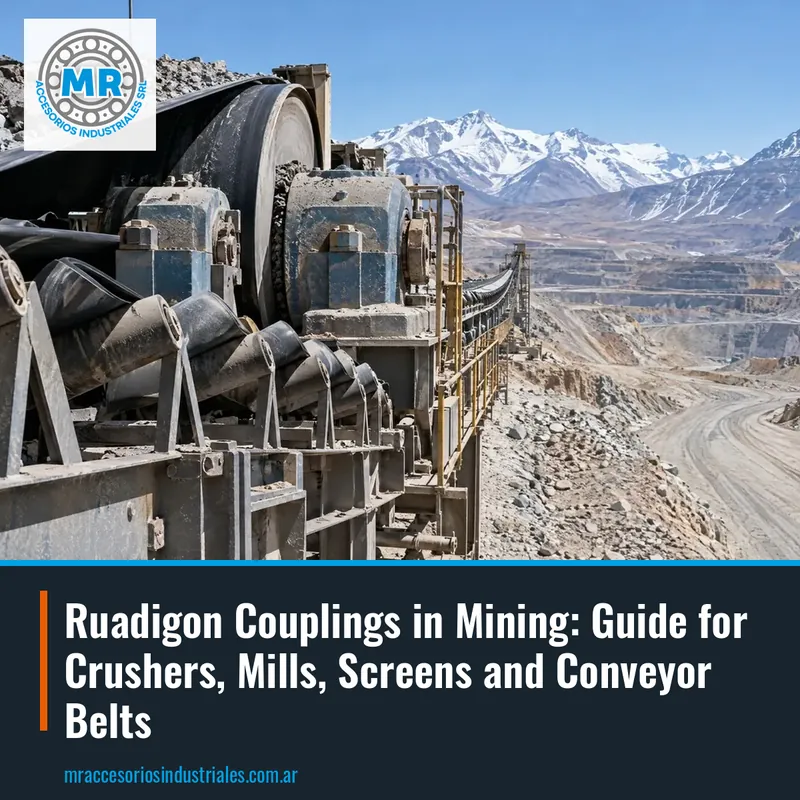
What are Ruadigon couplings and why are they used in mining
Ruadigon couplings are power transmission elements that join two shafts to transfer rotational motion from a motor to a machine. In mining they are used in equipment such as crushers, mills, screens and conveyor belts, where loads are heavy and working conditions demanding. Their design with elastic band allows absorbing misalignments, vibrations and shocks, which protects bearings and prolongs the useful life of the assembly. When choosing a coupling for mining, it is key to consider the torque to be transmitted, the rotation speed and the available space between shafts.
The elastic band of Ruadigon couplings acts as a flexible element that compensates for small angular, radial and axial misalignments. This is essential in mining equipment that suffers settlements, thermal expansions or structural movements during operation. In addition, the band absorbs impacts and vibrations, reducing the transmission of dynamic loads to neighboring components. That is why they are found in applications where reliability and low maintenance are priorities.
In the Argentine mining industry, Ruadigon couplings are used both in processing plants and in mineral transport systems. As a power transmission product, their correct selection directly impacts equipment availability. Therefore, when in doubt, it is advisable to consult a specialist who can verify the measurements and required torque.
Ruadigon couplings in crushers: critical points
Jaw, cone or impact crushers work with highly variable loads and torque peaks when large material enters. Ruadigon couplings installed between the motor and the flywheel must withstand these stresses without failing. The elastic band helps smooth starts and stops, preventing breakage in shafts or bearings. It is common to find medium to large couplings in these equipment, depending on motor power.
To order a coupling for a crusher, it is necessary to know the shaft diameters, the distance between ends and the motor power. It is also advisable to check if the original coupling has marks or engraved codes that allow identifying the exact model. In many cases, Ruadigon couplings are replaced by the same model, and a dimensional equivalence can also be evaluated. It is always better to send photos and measurements so that the technical team confirms the correct option.
A frequent error is choosing a coupling only by shaft diameter, without considering the peak torque that the crusher can generate. This can lead to premature wear of the elastic band or breakage of the hub. Therefore, when quoting, it is convenient to indicate the crusher model, motor power and operating conditions. This ensures that the selected coupling has the adequate capacity for mining work.
Ruadigon couplings in mills: vibration absorption
Ball, rod or SAG mills generate constant vibrations and misalignments due to eccentric loads and the movement of mineral inside. Ruadigon couplings with elastic band are ideal for these applications because they isolate vibrations and protect the motor and gearbox. They are typically installed between the motor and the reducer, or between the reducer and the pinion. The size selection depends on the nominal torque and the service factors recommended for mills.
In mills, it is common for couplings to work in environments with dust, humidity and high temperatures. The elastic band should be checked periodically to detect wear or hardening. If the band cracks or loses elasticity, it must be replaced to avoid major damage to the hubs. Predictive maintenance of couplings helps plan plant shutdowns without surprises.
When requesting a coupling for a mill, the shaft measurements, the distance between hubs and the motor power must be indicated. It is also useful to know if the original coupling was elastic band or another type, to evaluate the adaptation. Example codes such as X-4 · Banda elástica or X-5 · Banda elástica can serve as reference, but actual dimensions must always be verified. With that data, the MR team can quote the appropriate spare part.
Ruadigon couplings in screens: working with misalignment
Vibrating screens for mineral classification operate with oscillatory movements that generate constant misalignments between the motor and the eccentric shaft. Ruadigon couplings with elastic band allow absorbing these movements without transmitting harmful stresses to the bearings. Small to medium size couplings are usually used, depending on motor power and vibration amplitude. The flexibility of the band is key to avoid fatigue in the shafts.
In screens, the coupling must withstand not only the starting torque but also the radial and axial loads produced by vibration. Therefore, the elastic band must be in good condition and properly tensioned. Excessive wear of the band can cause shocks and noises that are transmitted to the entire structure. When detecting abnormal vibrations, it is advisable to check the coupling along with the bearings and housings.
To order a coupling for a screen, it is recommended to measure the shaft diameters and the distance between the ends of the hubs. It is also useful to know the brand and model of the screen, since many manufacturers specify the original coupling. If that information is not available, a photo of the installed coupling and the main measurements can be sent. With that data, the corresponding Ruadigon model can be identified or an equivalent alternative proposed.
Ruadigon couplings in conveyor belts: reliable transmission
Mineral conveyor belts move large volumes of material and require reliable, low-maintenance power transmission. Ruadigon couplings are installed between the motor and the speed reducer, or between the reducer and the drive pulley. Their elastic band compensates for misalignments caused by structure settlement or thermal expansion. This reduces unplanned stops and maintenance costs.
In conveyor belts, couplings usually work in environments with dust and humidity, so the elastic band must be resistant to abrasion and chemical agents. When selecting a coupling, the motor power, belt speed and the service factor recommended for conveyors must be considered. An oversized coupling can be as harmful as an undersized one.
To quote a coupling for a conveyor belt, the shaft diameters, the distance between hubs and the motor power are needed. It is also convenient to indicate if the current coupling is elastic band or another type, and if there is enough space for assembly. Codes such as X-2 · Banda elástica or X-4 · Banda elástica can be starting points, but actual measurements must always be confirmed. The MR team can help select the correct model.
How to identify a Ruadigon coupling and what data to send
To identify a Ruadigon coupling, the first step is to look for marks or codes engraved on the hubs or on the elastic band. Many couplings have the model number stamped on the metal, which facilitates exact replacement. If no mark is found, the shaft diameters, the distance between hub ends and the band width must be measured.
In addition to the measurements, it is convenient to record the application: type of machine, motor power, rotation speed and operating conditions. With that data, the required torque can be determined and the appropriate coupling selected. In the case of Ruadigon elastic band couplings, models such as X-2 · Banda elástica, X-4 · Banda elástica and X-5 · Banda elástica serve as reference. The final selection must be based on the application data.
A common mistake when ordering a coupling is sending only a photo without measurements or context. Although the photo helps identify the type of coupling, it does not allow verifying shaft diameters or the distance between hubs. Therefore, it is always recommended to accompany the photo with the main measurements and machine information. This way, delays are avoided and the quoted spare part is ensured to be the correct one for the mining application.
Common mistakes when mounting Ruadigon couplings in mining
One of the most frequent errors is forcing the mounting of the hubs on the shafts without verifying the proper fit. If the fit is too tight, the hubs or shafts can be damaged; if it is too loose, slipping and premature wear occur. The tolerance recommended by the manufacturer must always be respected and appropriate tools used. In mining, where equipment is large, poor assembly can cause costly stops.
Another common error is not correctly aligning the shafts before installing the elastic band. Although the band tolerates misalignments, excessive misalignment reduces its useful life and generates vibrations. It is recommended to use a dial indicator or ruler to verify angular and radial alignment within the allowed limits. In addition, the band must be properly centered and without twists, to avoid uneven loads.
Finally, many forget to check the condition of the elastic band during preventive maintenance. The band is the element that wears the most and its timely replacement prevents damage to the hubs. It should be visually inspected at each scheduled stop, looking for cracks or hardening. If any symptom is detected, it is convenient to quote the spare part immediately to have it ready for the next intervention.
Frequently asked questions
What Ruadigon coupling is used in a jaw crusher?
It depends on the motor power and shaft diameter. Generally, medium to large elastic band couplings are used. For a precise selection, send the shaft measurements, the distance between hubs and the motor power.
How do I identify the model of my Ruadigon coupling?
Look for marks or codes engraved on the hubs or on the band. If there are none, measure the shaft diameters, the distance between hub ends and the band width. With that data and a photo, we can identify the model.
Can I use a Ruadigon coupling on a vibrating screen?
Yes, elastic band couplings are suitable for screens because they absorb the misalignments and vibrations typical of those equipment. It is important to verify that the torque and measurements are adequate for your screen.
How often is the elastic band of a Ruadigon coupling changed?
There is no fixed period; it depends on operating conditions. It is recommended to inspect it at each scheduled stop and replace it if it shows cracks, hardening . In mining, the abrasive environment can accelerate wear.
What data do I need to quote a Ruadigon coupling for a mill?
We need the shaft diameters, the distance between hubs, the motor power and the type of mill. If you have the original coupling code or a photo, it also helps. With that we quote the correct spare part.
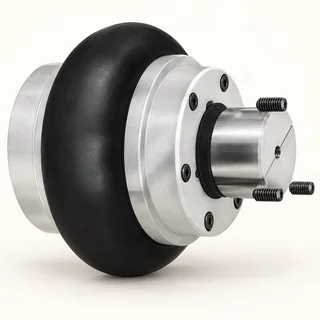
Products with photos in the catalogue
Keep reading
- Ruadigon in Argentina: complete guide to elastic couplings
Ruadigon is a brand of elastic couplings sold in Argentina. In this guide we review its product lines, typical applications, and how to get a quote by code.
- Ruadigon Codes: How to Read Coupling Designations
Practical guide to interpreting Ruadigon codes on elastic couplings. Understand the structure, prefixes, suffixes and real examples to order the correct replacement part.
- Ruadigon Couplings: Where They Are Used, How to Select Them, Installation and Maintenance to Make Them Last
Ruadigon elastic couplings are a reliable solution for transmitting power between shafts, absorbing misalignments and vibrations. In this guide we explain how to choose them according to the application, install them correctly and maintain them to extend their service life.
Continue here
Need a RUADIGON quote?
Send us the RUADIGON part number, the size or a photo of the part and we will get back to you with a quote.