
Blog
PEER dimensions: how to identify the code from the part and what data to send for a quote
Identify the code of a PEER bearing or housing from the dimensions and markings on the part. We tell you what data to send for a quote.
Technical team at MR Accesorios Industriales · Updated on November 18, 2026
Why it is key to identify the PEER code correctly
When a PEER bearing or housing fails, the first thing you need is to know exactly which part to replace. PEER dimensions are marked on the ring or on the housing, but sometimes they are worn or barely visible. Identifying the correct code prevents ordering a part that does not fit or does not support the load. At MR we help you decipher those markings so you order what you really need.
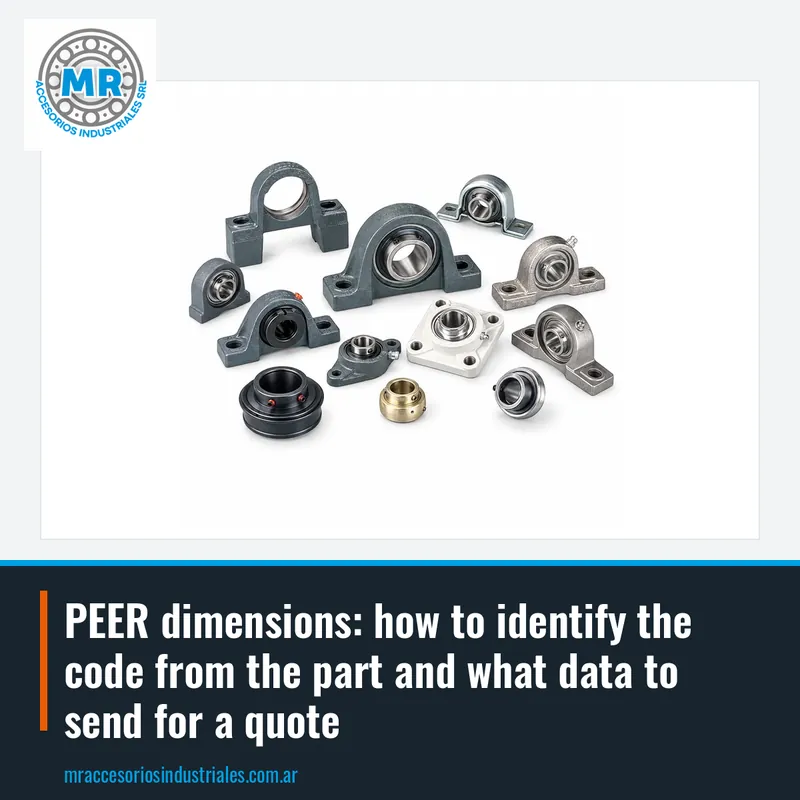
PEER Y bearings and housings with PEER insert bearing are easy-to-mount parts, because they come with a spherical outer ring. That allows them to self-align inside the housing, which reduces the risk of failures due to misalignment. That is why it is so important to respect the original dimensions.
A common mistake is to rely only on the shaft diameter and forget the width or the shape of the outer ring. If you have the old part, a photo of the markings is a good starting point. We quote you the exact replacement or the compatible alternative.
How to read the markings on a PEER bearing
PEER bearings have an alphanumeric code marked on one of their side faces. That code combines letters and numbers that indicate the series, the bore diameter and special features. For example, a code like GR201-8 corresponds to a Y bearing with a 1/2 inch bore.
In Y bearings, the numeric suffix after the hyphen indicates the shaft diameter in sixteenths of an inch. Thus, 201-8 means the bore is 8/16, that is, 1/2 inch. The initial letters, such as GR or HC, are part of the code and it is best to write them down exactly as they appear.
If the part is very worn and the code cannot be read, you can measure the inner diameter, the outer diameter and the width with a caliper. With those three dimensions, at MR we can identify the equivalent PEER bearing. It also helps to know whether the bearing has set screws, an eccentric collar or another shaft locking system. Send us a photo and the dimensions, and we will tell you which code corresponds.
PEER Y bearings: dimensions and variants
PEER Y bearings, also called inserts, are mounted directly on the shaft and are housed in a housing. Some examples are GR201-8, HC201-8 and HC202-9. The number after the hyphen indicates the bore diameter in sixteenths of an inch.
These bearings have a spherical outer ring that allows them to align inside the housing. That compensates for small misalignments of the shaft or the structure.
To quote a PEER Y bearing, we need the full code if you have it, or the bore, outer diameter and width dimensions. It is also advisable to indicate the type of shaft locking. If you are not sure, send us a photo of the part and of the place where it is mounted. We will tell you the correct option.
Y housings with PEER insert bearing
PEER Y housings are bodies that house an insert bearing. They come in different configurations: pillow block (UCP), take-up (UCT) and others. The housing code indicates the type of body and the size of the bearing it takes. For example, UCP201-8 is a pillow block housing with a bearing for a 1/2 inch shaft.
The housing and the insert bearing work together: the spherical outer ring is housed in the body. If you only change the bearing and the housing is damaged, the assembly can fail prematurely. That is why it is advisable to check the condition of both parts.
When quoting a PEER housing, tell us the full code if you see it on the body. If not, measure the distance between the centers of the mounting holes and the shaft diameter. It also helps to know whether it has a grease nipple. With that data, we quote you the exact assembly or the bearing separately.
Common mistakes when ordering PEER dimensions
One of the most frequent mistakes is to confuse the bore diameter with the outer diameter. The PEER code refers to the bore, not to the overall size of the bearing. For example, a 201-8 bearing has a 1/2 inch bore, but its outer diameter is larger. If you order by the outer diameter, you will be quoted the wrong part.
Another mistake is to omit the letters of the code. Check whether the code has letters such as GR or HC, and write them down exactly as they appear.
It also happens that only the bearing is ordered when the housing is damaged. If the body has cracks or the seat is ovalized, the new bearing will not last. Check the housing and, if you have doubts, send us photos of both parts. We advise you so you buy what you really need.
How to measure a PEER part with no visible code
If the code has been erased, you can take the dimensions with a caliper. For a Y bearing, measure the inner diameter (bore), the outer diameter and the overall width. Write down the dimensions in millimeters and in inches if you can. With those three values, at MR we can identify the equivalent PEER bearing.
In the case of a housing, measure the distance between the centers of the mounting holes, the width of the base and the overall height. It is also useful to know the bore diameter of the bearing that goes inside. If the housing has an identification plate, take a photo of it even if it is worn: sometimes part of the code can be made out.
When you send the dimensions, specify whether the part works in agricultural equipment, a conveyor or an industrial machine. That helps us verify that the suggested bearing supports the load and speed conditions. You do not need to be an expert: with a photo and the basic dimensions, we do the rest.
What data to send to quote PEER dimensions
To quote a PEER bearing or housing, the ideal is for you to send us the full code if you have it. If not, send a photo of the part where the markings are visible, and the dimensions you can take. The more information you give us, the faster we send you the quote. Do not forget to indicate the quantity you need.
If you are replacing a part from another brand, you can also send us that code. We look for the PEER equivalent and quote it for you. At MR we work with PEER Y bearings and housings, and we help you avoid ordering mistakes.
You can write to us by WhatsApp or email with the part data. If you have doubts about how to measure or which code corresponds, ask us. We reply promptly with the information you need. We supply PEER and help you find the exact dimension for your application.
Frequently asked questions
How do I identify the code of a PEER bearing?
Look for the markings on one of the side faces of the bearing. The alphanumeric code indicates the series and the bore diameter. If it cannot be read, measure the inner diameter, outer diameter and width, and send us a photo.
What does the number after the hyphen in a PEER code mean?
In PEER Y bearings, the number after the hyphen indicates the bore diameter in sixteenths of an inch. For example, 201-8 means an 8/16 bore, that is, 1/2 inch.
Can I use a PEER bearing instead of another brand?
If you have the code of the original part, send it to us and we will quote the equivalent PEER.
What data do I need to quote a PEER housing?
Send us the full code of the housing if you see it, or the dimensions of the distance between mounting holes, base width and shaft diameter. A photo of the body also helps to identify the model.
Does MR supply PEER bearings and housings?
Yes, at MR we supply PEER Y bearings and housings with insert bearing. You can consult us by WhatsApp or email with the code or the dimensions, and we will send you the quote.
Products with photos in the catalogue
Keep reading
- GUMMI Couplings: Vibration Absorption and Reliable Power Transmission for Industry
GUMMI elastic couplings absorb vibrations and misalignments, protect machinery, and ensure reliable power transmission. Learn about their configurations and how to choose the right model.
- Tsubaki industrial chains: quality, durability and performance for demanding applications
Discover the types of Tsubaki chains we supply: roller, conveyor, leaf, freewheels, couplings and torque limiters. We help you choose the right one for your application.
- SKF Chains: Reliable Power Transmission for Industrial Applications
SKF roller chains offer strength and precision for power transmission in industrial machinery. Learn about the PHC series, ASA and BS standards, and how to identify the correct chain for your equipment.
Continue here
Need a PEER quote?
Send us the PEER part number, the size or a photo of the part and we will get back to you with a quote.