
Blog
How to choose a LOVEJOY jaw coupling and request a quote by code
We explain how to identify a LOVEJOY L-series jaw coupling, how to read its code, and what information to send for an accurate quote.
LOVEJOY catalog by part number
Technical team at MR Accesorios Industriales · Updated on November 15, 2026
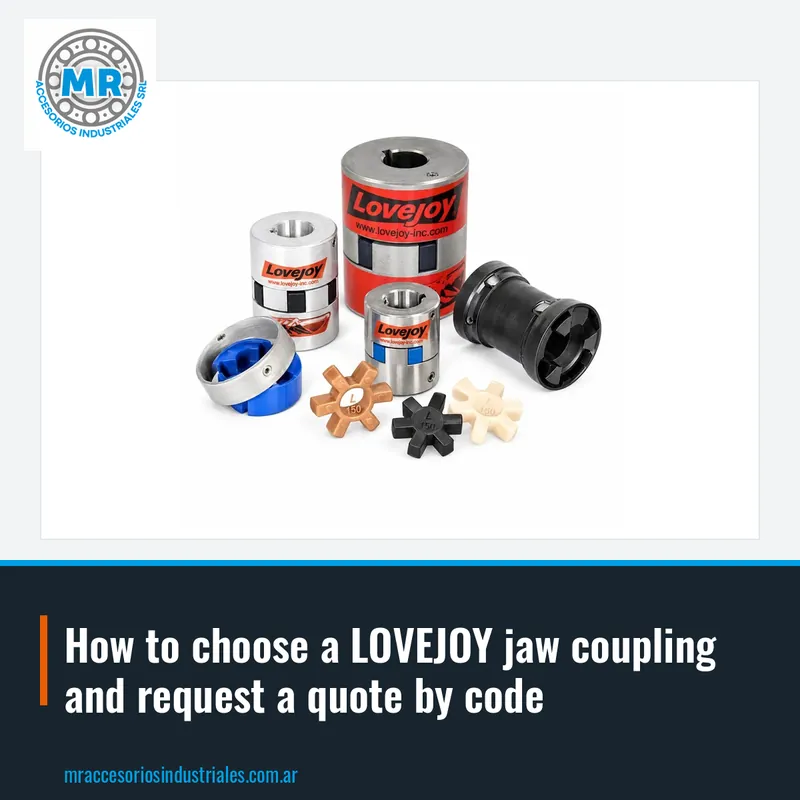
What LOVEJOY couplings are and what they are used for
LOVEJOY couplings are power transmission elements that connect two shafts to transfer motion and torque, absorbing misalignments and vibrations. In Argentine industry, they are found in pumps, compressors, gearboxes, conveyors, and lifting equipment. Their main function is to protect the connected components, preventing excessive loads and premature wear. Choosing the correct coupling improves the service life of the entire system.
At MR we market and distribute LOVEJOY couplings for maintenance and new projects. As they are precision parts, it is key to identify the exact model to ensure compatibility with the shafts and working conditions.
Each LOVEJOY coupling is designated by a code. For example, L190, L276, and L225 are L-series jaw couplings. Knowing the code allows you to request spare parts without errors and speeds up the quote. In this guide, we review how to identify this type of coupling and the data you need to request the right one.
Jaw couplings: how they are made up
LOVEJOY jaw couplings are used in general applications due to their simple design. They consist of two metal hubs with jaws that engage in a central elastomeric spider. This spider absorbs impacts, vibrations, and slight misalignments, protecting the connected equipment. They are ideal for centrifugal pumps, fans, and machine tools.
Within the L series, codes such as L190, L276, and L225 identify specific sizes. To order a spare part, it is advisable to verify the code engraved on the hub. If it is not legible, you can measure the outer diameter and total length to identify it.
When requesting a quote for a LOVEJOY jaw coupling, it is helpful to send photos of the part and equipment data. You should also indicate whether you need the complete coupling or only the replacement spider. At MR we quote the code you need. Avoid improvising with approximate measurements, as an incorrectly sized coupling can damage the shafts.
What data to gather before ordering the coupling
Before ordering a coupling, it is advisable to survey the equipment. The basic data are the diameter of each shaft, the length of the keyways, and the distance between the shaft ends. With these measurements, you verify that the hubs fit the motor and the driven machine.
It is also useful to note the type of machine: pump, fan, conveyor, or gearbox. If you have the motor plate, send a photo. At MR we help you locate the LOVEJOY code that corresponds to your equipment.
Other useful data are the motor power and speed, and whether there are strong impacts or vibrations at startup. With that information, we indicate the most suitable LOVEJOY model.
The elastomeric spider: the most frequently replaced part
In a jaw coupling, the spider is the flexible part between the two hubs. It absorbs impacts and vibrations, and therefore is the first to wear. Checking it at every maintenance stop prevents damage to the hubs.
A worn spider usually shows cracks, deformation, or material loss. If the equipment makes noise or vibrates more than before, it is advisable to disassemble the coupling and inspect it. To order a new one, indicate the code of the complete coupling.
When changing the spider, also check the condition of the hubs. Sometimes the hub can be reused and only the flexible part renewed. If in doubt, send us a photo and we will guide you.
How to measure the coupling if the code is not legible
When the code is erased by use, the coupling can be identified with a caliper. Measure the outer diameter of the hubs, the total length of the assembled coupling, and the bore diameter of each hub.
Also note the keyway width and whether the hub has a set screw. With these measurements and a front and side photo, at MR we can locate the corresponding L-series code.
To quote, we need the code engraved on the hub or the shaft measurements. If the coupling is very damaged, a photo helps identify the type.
How to identify your LOVEJOY coupling by code and measurements
Identifying a LOVEJOY coupling is simple if you know where to look. Most hubs have the code stamped on the body or flange. For example, jaw couplings carry a designation such as L190, L276, or L225. If the code is erased, measurements can be taken with a caliper: outer diameter, total length, and bore diameter.
For the spider, color and dimensions are also useful data. If you are going to replace only the spider, indicate the coupling code and send a photo of the used part to avoid mistakes.
When sending your inquiry to MR, attach photos of the part from various angles and, if possible, of the equipment where it is mounted. With the code or measurements, we quote the LOVEJOY coupling you need. Avoid ordering by vague descriptions such as “small coupling” or “the one on the pump,” because there are hundreds of variants. The more information you give us, the faster we respond.
Common mistakes when ordering or mounting LOVEJOY couplings
One of the most frequent mistakes is ordering a coupling only by shaft diameter, without considering motor power. A coupling that fits the shaft may not be suitable for the load. At MR we help you choose the LOVEJOY coupling according to your application.
Another common mistake is not taking care of alignment. Although flexible couplings tolerate misalignments, exceeding the limits accelerates spider wear. When mounting, use a straightedge or laser to align the shafts within the indicated tolerances. A neat installation extends the life of the coupling and bearings.
There is also the mistake of reusing old or damaged spiders. A worn spider transmits vibrations and can damage the hubs. When replacing, order the spare part by the coupling code. At MR we quote what you need via WhatsApp or email.
Frequently asked questions
How do I know which LOVEJOY coupling my pump has?
Check the code engraved on the coupling hub. If it is not legible, measure the outer diameter, total length, and shaft diameters. With that data and a photo, at MR we identify the corresponding LOVEJOY model.
Can I replace only the spider of my LOVEJOY coupling?
Yes, in jaw couplings only the elastomeric spider can be changed. It is important to indicate the color, hardness, and dimensions, or the complete coupling code, to get the exact replacement.
What is the purpose of the spider in a jaw coupling?
It is the flexible part between the two hubs. It absorbs impacts, vibrations, and small misalignments, and protects the shafts and hubs.
How do I request a quote for a LOVEJOY coupling at MR?
Send via WhatsApp or email the coupling code (for example, L190, L276, or L225) or the measurements and photos of the part. We will respond promptly with the quote.
What photo should I send to identify the coupling?
One from the front, one from the side, and another showing the code engraved on the hub, if legible. If possible, add a photo of the equipment where it is mounted.
Products with photos in the catalogue
Keep reading
- GUMMI Couplings: Vibration Absorption and Reliable Power Transmission for Industry
GUMMI elastic couplings absorb vibrations and misalignments, protect machinery, and ensure reliable power transmission. Learn about their configurations and how to choose the right model.
- Tsubaki industrial chains: quality, durability and performance for demanding applications
Discover the types of Tsubaki chains we supply: roller, conveyor, leaf, freewheels, couplings and torque limiters. We help you choose the right one for your application.
- SKF Chains: Reliable Power Transmission for Industrial Applications
SKF roller chains offer strength and precision for power transmission in industrial machinery. Learn about the PHC series, ASA and BS standards, and how to identify the correct chain for your equipment.
Continue here
Need a LOVEJOY quote?
Send us the LOVEJOY part number, the size or a photo of the part and we will get back to you with a quote.