
Blog
Link-Belt in mining: what is used in crushers, mills, screens and conveyor belts, and how to order it
We review the most used Link-Belt bearings and housings in mining equipment, how to identify them and what data to send for a quote.
LINK-BELT catalog by part number
Technical team at MR Accesorios Industriales · Updated on November 1, 2026
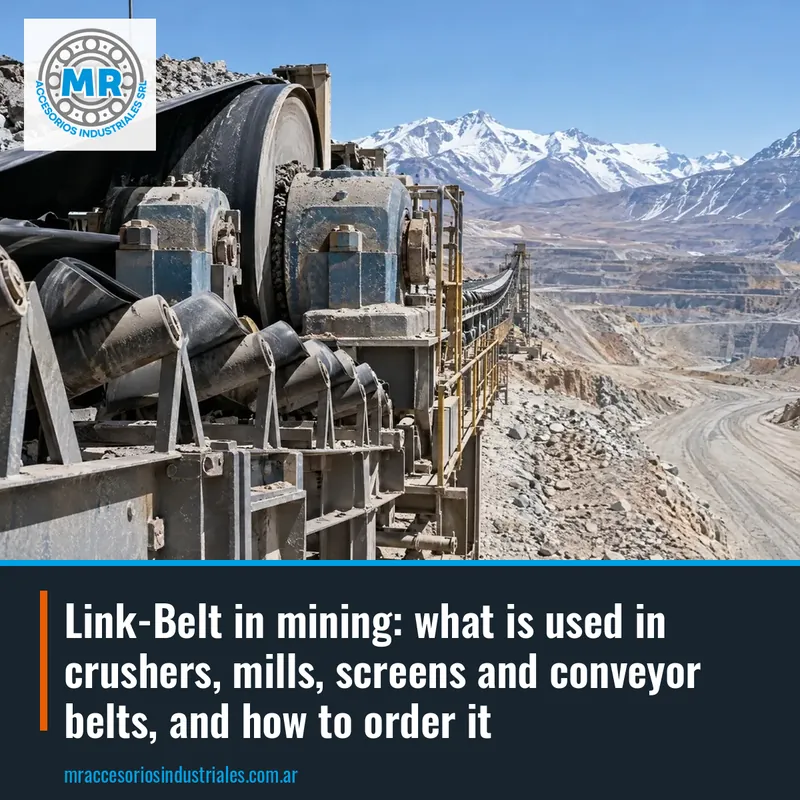
Link-Belt Y bearings and inserts in mining equipment
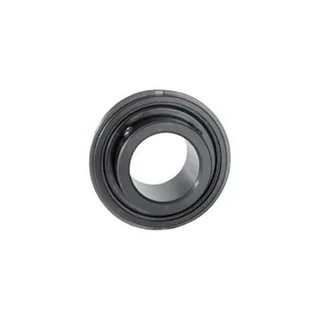
In mining, Link-Belt Y bearings and inserts are used at points where the shaft is already mounted and the housing is part of the structure, such as in conveyor belt pulleys or tension rollers. They are recognized by their spherical outer shape and the extended inner ring with set screws or eccentric locking collar. Codes in this line include ER20, ER22 and ER40.
When ordering a Y bearing and insert for mining, it is advisable to verify the shaft diameter in millimeters or inches, because there are metric and inch series. You should also check whether the insert has a single or double seal, since double-sealed versions are preferred in dusty or humid environments. The engraving on the outer ring usually includes the Link-Belt code and sometimes the serial number, which makes exact replacement easier.
A common mistake is confusing the insert with a standard deep groove ball bearing: the Y insert has a spherical outer profile that allows it to self-align within the housing. If the original insert is badly damaged and the code cannot be read, you can measure the bore, outer diameter and width, and with that data MR will quote the equivalent Link-Belt alternative.
Link-Belt spherical roller bearings for heavy loads
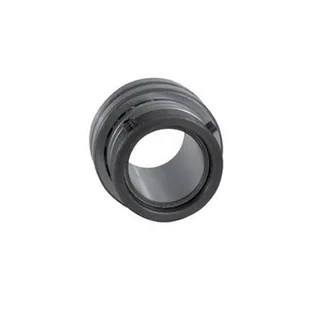
Link-Belt spherical roller bearings are chosen in crushers and mills because they support combined radial and axial loads and tolerate shaft or housing misalignment. Their design with two rows of rollers and a spherical raceway in the outer ring provides this self-aligning capability. In mining they appear in the main shaft bearings of jaw or gyratory crushers, and in the trunnions of ball mills.
Codes in this line usually start with B, such as B635L, B419L and B455L. To identify them on the part, look for the engraving on the front face of the outer ring or on the edge of the inner ring. If the bearing is mounted, sometimes the code can be seen with a flashlight without disassembling the entire equipment.
When quoting a Link-Belt spherical roller bearing for mining, it is advisable to send the complete code, the dimensions (bore, outer diameter and width) and a photo of the part. It is also useful to know whether the original bearing had a cylindrical or tapered bore, because in some mills they are used with an adapter sleeve. MR distributes this line and advises you on the correct replacement.
Link-Belt cylindrical roller bearings in mining drives
Link-Belt cylindrical roller bearings are used in gearboxes, motors and other transmission components of mining equipment where there are high speeds and radial loads. Unlike spherical roller bearings, they do not support significant misalignment, but they have higher radial load capacity and lower friction.
Link-Belt cylindrical roller bearing series include the 6200, 1000 and 1200 series. To order a Link-Belt cylindrical roller bearing, you must identify the code engraved on the ring, which usually includes the serial number and sometimes suffixes indicating the cage or seal type. If the code cannot be read, measure the bore, outer diameter and width, and indicate whether it is single-row or double-row.
A frequent mistake is replacing a cylindrical roller bearing with a deep groove ball bearing thinking they are equivalent: they are not, because the cylindrical one supports much higher radial loads and has different rigidity. In mining, where loads are extreme, it is best to respect the original type. MR sells Link-Belt cylindrical roller bearings and helps you confirm the correct reference.
Link-Belt housings for bearings in mining
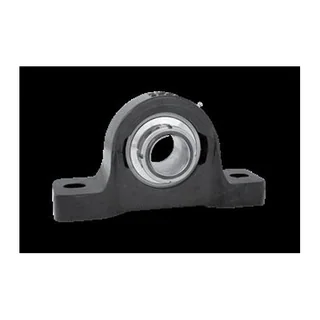
Link-Belt housings are the parts that house the bearing and fix it to the equipment structure, such as in conveyor belt frames or screen shaft bearings. In mining, pillow block housings for horizontal shafts and flange housings for vertical mountings are widely used.
Link-Belt housing codes usually combine letters and numbers, such as PA344, 68564 and PA327. To order a housing, you need to know the code of the bearing that goes inside, because the housing is selected according to the bearing outer diameter and the fixing type. The diameter of the mounting holes and the center distance also matter.
A common mistake when replacing a housing is not checking whether the original bearing was self-aligning or not: housings for Y bearings have a spherical cavity, while those for spherical roller bearings have a cylindrical or tapered seat. If the housing is cracked or heavily corroded, it is advisable to send photos and dimensions to MR so they can quote the equivalent Link-Belt.
Link-Belt Y housings with insert bearing
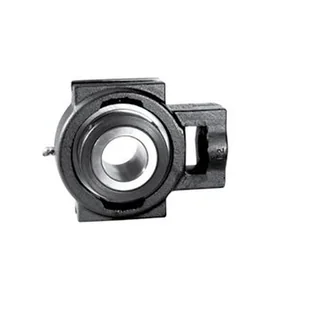
Link-Belt Y housings with insert bearing are complete units that combine the housing and the insert in a single assembly, ready to mount. They are used in mining conveyor belts, return rollers and low-speed shafts where quick and simple mounting is needed. The housing has a spherical cavity that allows the insert to self-align.
Codes for these units usually start with TU, such as TU320, TU322 and TU323. To order a complete unit, indicate the housing and insert code, or directly the unit code if it is engraved on the plate or on the body.
In mining there is dust and humidity, so it is advisable to ask about the seal type. When replacing a unit, verify the shaft fixing type: set screws, eccentric locking collar or adapter sleeve. MR distributes Link-Belt Y housings with insert and advises you on the right configuration for your equipment.
How to identify a Link-Belt bearing in the field
To order a Link-Belt spare part in mining, the first step is to read the code engraved on the bearing or housing. It is usually on the front face of the outer ring, on the edge of the inner ring or on a metal plate on the housing. If the part is very dirty, you can clean it with a cloth and use a raking flashlight to highlight the engraving.
When the code cannot be read, you can take the main dimensions: bore, outer diameter and width, in millimeters or inches. It also helps to identify the bearing type: deep groove ball, Y insert, spherical or cylindrical roller. With that data and a photo, MR can identify the corresponding Link-Belt reference.
Another useful piece of data is the equipment where it is mounted: crusher, mill, screen or conveyor belt, and the exact position (drive pulley, tension pulley, countershaft). The equipment manual often includes the bearing list with original codes, which speeds up the quote. MR sells Link-Belt products for mining and helps you find the correct spare part.
Common mistakes when ordering Link-Belt bearings for mining
A frequent mistake is ordering only by bore diameter, without verifying the bearing type or width. Two bearings with the same bore diameter can have different outer diameter, width or internal design, and may not be interchangeable. That is why it is advisable to send the complete code or the three dimensions and a photo.
Another mistake is not considering the working environment: in mining there is dust, humidity, vibrations and impact loads. Therefore, it is not advisable to replace a bearing with one of a different type. MR advises you on the characteristics required for your equipment.
It is also common to confuse the housing with the bearing: the housing is the part fixed to the structure, and the bearing goes inside. If one is damaged, it is sometimes advisable to replace the complete assembly, especially in Y units. When quoting, indicate whether you need only the bearing, only the housing or the complete unit.
Frequently asked questions
What Link-Belt bearings are used in crushers?
Crushers mainly use Link-Belt spherical roller bearings, such as those in the B series, due to their ability to support heavy loads and misalignment. Cylindrical roller bearings may also appear on countershafts. To order them, it is advisable to send the engraved code or the dimensions and a photo.
How do I identify a Link-Belt bearing if the code cannot be read?
If the code cannot be read, measure the bore, outer diameter and width, and take photos of the part. With that data, MR can identify the equivalent Link-Belt reference. It also helps to know in which equipment and position it is mounted.
Does Link-Belt manufacture housings for mining?
Yes, MR sells Link-Belt housings and complete units with insert bearing. Codes such as PA344 or TU320 correspond to housings and units used in conveyor belts and other mining equipment.
What is the difference between a Y bearing and a Link-Belt spherical roller bearing?
The Y bearing is an insert with a spherical outer ring that mounts in a housing with a spherical cavity, to self-align. The spherical roller bearing has two rows of rollers and a spherical raceway in the outer ring, and supports much higher loads and misalignment. In mining, both are used depending on the application.
How do I get a quote for Link-Belt bearings for mining from MR?
You can send via WhatsApp or email the bearing or housing code, the dimensions (bore, outer diameter and width) and a photo of the part. Also indicate the equipment where it is mounted. MR will quote you promptly.
Products with photos in the catalogue
Keep reading
- Link-Belt Split Housings: Efficient Solutions for Demanding Industrial Applications
Discover the Link-Belt line of split housings and mounted bearings, designed to withstand heavy loads and adverse conditions in Argentine industry. We quote the exact model you need.
- How to read Link-Belt codes: designation structure, prefixes, suffixes and real examples
Practical guide to interpreting the nomenclature of Link-Belt housings and bearings. Understand what each part of the code indicates and get a quote for the correct part.
- Link-Belt by industry: where it is used, how to select it, mounting and maintenance to make it last
We tell you in which industries Link-Belt housings and bearings are used, how to choose the correct model and what mounting and maintenance care extends their service life.
Continue here
Need a LINK-BELT quote?
Send us the LINK-BELT part number, the size or a photo of the part and we will get back to you with a quote.