
Blog
How to identify a GATES belt by its code and get a quote
We review the GATES belt lines we supply in Argentina, their typical applications, and the data needed to request an accurate quote.
Technical team at MR Accesorios Industriales · Updated on October 10, 2026
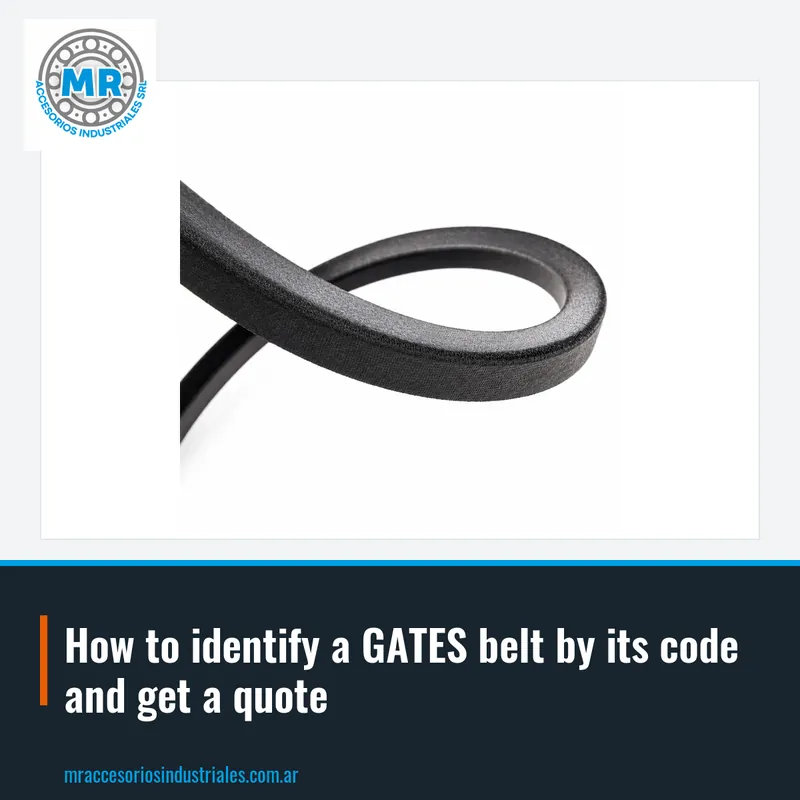
GATES belts: what they are and where they are used
GATES belts are power transmission elements used in a wide variety of industrial machines and agricultural equipment. They transmit motion between pulleys efficiently and with low maintenance. In Argentina, we supply these belts for different sectors, from the food industry to metalworking. Their design absorbs vibrations and reduces noise compared to other transmission systems.
Within the GATES line, we mainly find two types: synchronous belts and V-belts. The former are characterized by teeth that mesh with toothed pulleys, ensuring transmission without slippage. The latter, with a trapezoidal cross-section, work by friction on grooved pulleys and are very common in standard applications. Each has advantages depending on speed, load, and required precision.
To quote a GATES belt, it is advisable to have on hand the code engraved on the belt or, failing that, the main measurements. If the belt is very worn and the code is unreadable, you can measure the outside length, width, and tooth pitch in the case of synchronous belts. With that information, we indicate the correct alternative within the GATES line.
GATES synchronous belts: precision and synchronism
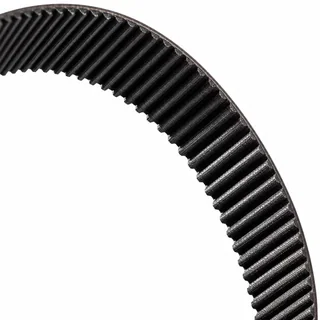
GATES synchronous belts stand out for their precise toothing, which maintains exact synchronization between shafts. They are ideal for applications where slippage is not admissible, such as engine timing systems or robotics. In Argentine industry, they are used in machine tools, industrial printers, and packaging equipment.
A typical example of this line is code 90-2MGT3, which corresponds to a synchronous belt with metric pitch GT3. The nomenclature indicates the length in millimeters (90) and the tooth profile (2MGT3). Other frequent codes are 76-2MGT3 and 80-2MGT3, which vary in length. These codes are usually engraved on the back of the belt, although they can wear off with use.
When ordering a GATES synchronous belt, it is key to indicate the full code if known. If not, measure the tooth pitch, width, and number of teeth. It is also helpful to know if the belt operates in an environment with oil or high temperatures, because special versions exist. With that data, we quote the exact belt or its equivalent within the same brand.
GATES V-belts: versatility for industry
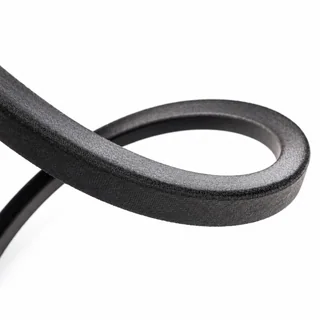
GATES V-belts are the most widespread in industrial power transmission. They are used in pumps, compressors, fans, and agricultural machinery, among other equipment. Their V-shaped cross-section provides good grip on grooved pulleys, even with some misalignment. They are easy to install and available in different sizes.
Within this line, we find codes such as A114, A132, and B104, which correspond to classic A and B profiles. The letter indicates the cross-section and the number, the nominal length in inches. For example, A114 is an A-profile belt with a nominal length of 114 inches. These codes follow an international standard, which facilitates replacement.
To quote a GATES V-belt, the most practical is to send the code engraved on the belt. If unreadable, measure the outside length with a flexible tape measure and the top width of the section. With that data, we identify the corresponding profile and length. It is also useful to know how many belts work in parallel on the same pulley, to recommend the complete set.
How to identify a GATES belt by its code
Each GATES belt has a code that summarizes its dimensions and main characteristics. In synchronous belts, the code usually includes the length in millimeters and the tooth profile, as in 90-2MGT3. In V-belts, the initial letter indicates the section and the number, the length in inches, as in A114. These codes are engraved on the belt surface, although they can wear over time.
If the code is not legible, measurements can be taken to reconstruct it. On a synchronous belt, measure the tooth pitch, width, and number of teeth. On a V-belt, measure the outside length and the top width of the section. With that data, the MR technical team can identify the corresponding GATES belt.
It is important not to confuse similar codes from different brands, because tolerances may vary. If you have a belt from another brand and want its GATES equivalent, send us the original code and measurements. We will indicate the correct option within the GATES line.
Typical applications of GATES belts in Argentina
GATES belts are found in a wide variety of equipment operating in Argentine industry. In agriculture, they are used in combine harvesters, tractors, and grain processing machines. In the food industry, they appear in conveyor belts, mixers, and packaging machines. They are also common in metalworking shops, in lathes, milling machines, and compressors.
Synchronous belts are preferred in applications requiring exact synchronism, such as engine timing systems or textile machinery. V-belts, on the other hand, are chosen for heavy loads and moderate speeds, such as in centrifugal pumps or industrial fans. In all cases, the correct choice of belt influences the efficiency and service life of the equipment.
When replacing a GATES belt, it is advisable to check the condition of the pulleys. A worn or misaligned pulley can damage the new belt in a short time. It is also recommended to verify the installation tension according to the manufacturer's instructions. If you have doubts about which belt corresponds to your machine, send us a photo of the old belt or the equipment plate and we will advise you.
Common mistakes when ordering or installing GATES belts
One of the most frequent mistakes when ordering a belt is confusing the profile or length. In V-belts, a wrong letter (for example, A instead of B) completely changes the section and will not fit the pulley. In synchronous belts, an incorrect tooth pitch can cause skipping and premature breakage. Therefore, it is essential to verify the code or measurements before quoting.
Another common mistake is installing the belt with inadequate tension. If it is too loose, it slips and wears quickly; if it is too tight, it overloads the bearings and can break the belt. Ideally, follow the specifications of the equipment manufacturer or GATES. Also, avoid forcing the belt with sharp tools, as this damages the internal structure.
When ordering a GATES belt, it is not enough to say 'the motor belt' or 'the long belt'. It is necessary to provide the code, measurements, or a clear photo of the part. If it is a set of belts working in parallel, they should all be replaced together so the load is distributed evenly. With that data, we quote the correct belt and avoid delays due to misunderstandings.
How to quote GATES belts at MR
To quote a GATES belt, you can write to us via WhatsApp or email with the part code. If you do not have the code, send us the main measurements or a photo of the old belt. With that information, the MR team identifies the product and sends you the quote promptly. We quote GATES synchronous and V-belts.
You can also ask us about GATES belts not listed in this guide. We supply a wide variety of references from the brand, and if you need a specific code, we will quote it. You do not need to tell us the exact use, but if you tell us which machine it goes on, we can guide you better. Our goal is for you to receive the correct belt for your application.
At MR, we handle inquiries from Buenos Aires, Argentina. We specialize in power transmission and supply brands such as GATES. If you have a worn or broken belt, send us a photo and the code if legible. We will respond with a quote promptly.
Frequently asked questions
How do I know which GATES belt my machine uses?
The most accurate way is to look for the code engraved on the old belt. If it is not legible, measure the outside length, width, and, for synchronous belts, the tooth pitch. With that data, we will indicate the correct GATES belt.
Can I replace a belt from another brand with a GATES one?
Yes, in most cases an equivalent GATES belt can be found. Send us the original code and measurements, and we will indicate the compatible option within the GATES line.
What is the difference between a synchronous and a V-belt?
The synchronous belt has teeth that mesh with toothed pulleys and does not slip, ideal for synchronism. The V-belt works by friction on V-pulleys and is more common in standard heavy-load applications.
What data do I need to quote a GATES belt?
The belt code is enough. If you do not have it, send the measurements (length, width, tooth pitch) or a clear photo of the part. With that, we will quote you promptly.
Where can I buy GATES belts in Argentina?
You can quote them with us at MR, from Buenos Aires, Argentina. Write to us via WhatsApp or email with the belt code or measurements and we will respond with the proposal.
Products with photos in the catalogue
Keep reading
- GUMMI Couplings: Vibration Absorption and Reliable Power Transmission for Industry
GUMMI elastic couplings absorb vibrations and misalignments, protect machinery, and ensure reliable power transmission. Learn about their configurations and how to choose the right model.
- Tsubaki industrial chains: quality, durability and performance for demanding applications
Discover the types of Tsubaki chains we supply: roller, conveyor, leaf, freewheels, couplings and torque limiters. We help you choose the right one for your application.
- SKF Chains: Reliable Power Transmission for Industrial Applications
SKF roller chains offer strength and precision for power transmission in industrial machinery. Learn about the PHC series, ASA and BS standards, and how to identify the correct chain for your equipment.
Continue here
Need a quote?
Send us the code, size or a photo of the part and we'll quote you shortly.