
Blog
Bearings and housings for cold storage: solutions for intensive washdown and low temperature
In the cold storage industry, bearings and housings must withstand high-pressure water washdown, constant humidity, and sub-zero temperatures. We tell you which options to consider and how to get a quote.
Technical team at MR Accesorios Industriales · Updated on September 28, 2026
The challenge of bearings in the cold storage industry
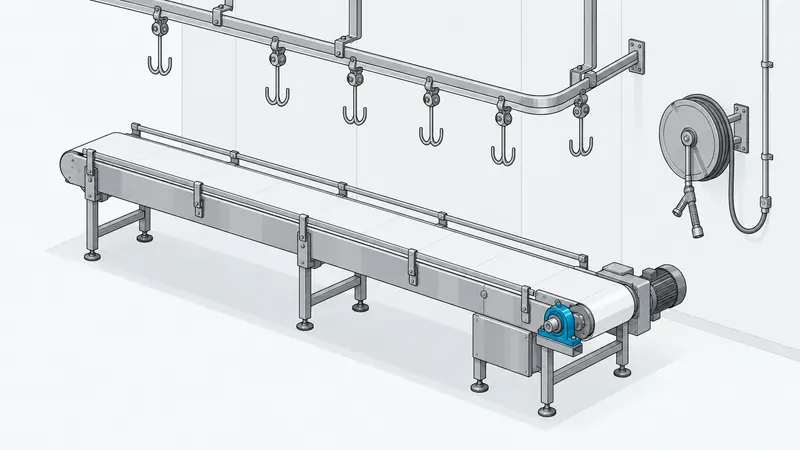
Equipment in a cold storage facility operates under extreme conditions: high-pressure water washdown, detergents and disinfectants, constant humidity, and temperatures ranging from ambient to below zero. In this context, a standard bearing fails quickly due to corrosion, lubricant loss, or contaminant ingress. Therefore, the selection of bearings and housings for cold storage must prioritize resistant materials and effective seals.
Intensive washdown is one of the biggest enemies of bearings. Pressurized water can penetrate the bearing if the seals are not adequate, washing away the lubricant and causing oxidation. Additionally, sudden temperature changes generate internal condensation. Therefore, in washdown areas, stainless steel bearings or those with special seals are recommended, along with housings designed to prevent water accumulation.
Stainless steel deep groove ball bearings for humid environments
Stainless steel deep groove ball bearings are a common choice in cold storage equipment exposed to washdown. Stainless steel resists corrosion and maintains rotational precision. Within this subcategory, we supply references such as W 627 and W 608, which are SKF stainless steel deep groove ball bearings.
These bearings are typically used in light applications, such as cutting conveyor belts, work tables, or packaging equipment. When choosing a stainless steel bearing, it is also important to verify the seal type: for intensive washdown, a contact seal (2RS) is recommended to prevent water and detergents from entering. If the equipment operates at low temperature, the appropriate lubricant must be considered, as some thicken with cold.
Y housings with insert bearing: the solution for long shafts
In conveyors, screw conveyors, and slaughterhouse equipment, Y housings with insert bearings are widely used because they allow quick mounting and absorb misalignments. For cold storage, housings with stainless steel or anti-corrosion treated bodies are recommended, along with insert bearings with triple-lip seals to withstand washdown.
We supply a wide variety of Y housings with insert bearings from brands such as DODGE, SEALMASTER, and SKF. For example, DODGE TB-GT-04 and TB-GT-09 housings, or SEALMASTER STMH-35 and TBMH-27, are designed for severe conditions. We also work with SKF pillow block housings such as P 72 and P 47.
When selecting a Y housing, pay attention to the shaft locking type (set screws, eccentric, or adapter sleeve), the housing material, and the load capacity. For intensive washdown, housings with stainless steel bodies and insert bearings with contact seals are ideal.
Y bearings (inserts) for mounting in housings
The Y bearing or insert is the component that goes inside the housing. It has a spherical outer ring that allows self-alignment and can be made of carbon steel or stainless steel. In cold storage, inserts with triple-lip seals and low-temperature lubricant are preferred.
Within this subcategory, we supply inserts such as DODGE INS-GT-09 and INS-GT-05, SKF UC 216 and UC 315, and LINK-BELT ER27 and ER23. These inserts cover different shaft diameters and load capacities, so it is key to verify the exact shaft size and working load.
For intensive washdown, some inserts come with an additional seal or a labyrinth design that improves protection. If the equipment is in a freezing area, an insert with special low-temperature lubricant can be chosen, which maintains its viscosity and does not harden.
Roller chains for transport in cold and humid environments
Roller chains are used in box conveyors, hooks, and drag systems. In cold storage, the chain must resist corrosion and maintain operation at low temperature. Stainless steel chains are an option, but nickel-plated or anti-corrosion treated chains are also used.
We supply roller chains from brands such as SKF, TSUBAKI, and EMMAR. For example, SKF PHC 81X-O/L and PHC 40-2C/L chains, or TSUBAKI RS60 and RS25. We also work with EMMAR chains such as 12-C1 and 10-C2.
When selecting a chain for cold storage, consider the pitch, material, and lubrication type. In humid environments, lubrication must be water-resistant and suitable for incidental food contact, if applicable. Additionally, maintenance should include periodic inspection of links and pins to detect premature wear.
Greases and lubrication for low temperature and washdown
Lubrication is critical in cold storage: an inadequate grease hardens with cold, increasing friction and energy consumption, or washes away with water, leaving the bearing unprotected. Therefore, synthetic food-grade greases (NSF H1) and water-resistant greases are recommended.
We supply greases and lubricants specifically for these conditions. When requesting a quote, it is important to indicate the working temperature, whether there is hot or cold water washdown, and whether the lubricant may come into contact with food. With that information, we recommend the appropriate product.
In addition to grease, it is key to establish an adequate relubrication program. In washdown areas, relubrication frequency can be reduced if sealed-for-life bearings are used, but for bearings with grease fittings, relubrication must be done with the correct grease and in the right amount to avoid contamination.
Radial seals: additional protection against water ingress
Radial seals complement bearing protection in cold storage equipment. They are mounted on the shaft and prevent water, detergents, and particles from entering, and retain lubricant. In intensive washdown environments, seals with double lip and stainless steel spring are recommended.
We supply a wide range of radial seals for different diameters and conditions. When requesting a quote, we need the shaft and housing dimensions, and the type of fluid to which it will be exposed. With that data, we indicate the appropriate seal.
In many cases, the combination of a sealed bearing and an external seal provides extra protection in critical applications, such as pumps, gearmotors, or gearboxes. It is important to verify the compatibility of the seal material with the detergents used in the plant.
Frequently asked questions
Which bearing is best for intensive washdown in cold storage?
For intensive washdown, stainless steel bearings with contact seals (2RS) or insert bearings with triple-lip seals are recommended. It is also key to use water-resistant greases suitable for low temperature.
Are Y housings with insert bearing suitable for low temperature?
Yes, as long as the insert bearing has a lubricant suitable for low temperature and seals that prevent condensation. Stainless steel or anti-corrosion treated housings are ideal for humid environments.
What grease to use in cold storage bearings?
Synthetic food-grade grease (NSF H1) that is water-resistant and performs well at low temperature is recommended. It is important to indicate the working temperature and whether there is food contact when requesting a quote.
How do I prevent bearings from rusting due to washdown?
Use stainless steel bearings or those with effective seals, and complement with radial seals. Also, perform preventive maintenance with adequate relubrication and periodically check the condition of the seals.
Which roller chains are suitable for cold storage?
Stainless steel or anti-corrosion treated chains are the most suitable. Lubrication must also be considered: it must be water-resistant and suitable for low temperature.
Continue here
Need a quote?
Send us the code, size or a photo of the part and we'll quote you shortly.