
Blog
How to Read Tsubaki Codes: Designation Structure, Prefixes, Suffixes, and Real Examples
Practical guide to interpreting the nomenclature of Tsubaki chains, freewheels, couplings, and other products. With real examples and tips for requesting quotes.
Technical team at MR Accesorios Industriales · Updated on September 28, 2026
Why is it important to understand Tsubaki codes?
When working with power transmission, correctly identifying a component is key to avoiding plant downtime and purchasing errors. Tsubaki codes follow an internal logic that, once you know it, allows you to deduce product type, series, and main characteristics without needing a catalog.
In this guide, we explain how to read the most common Tsubaki designations, with real examples of roller chains, freewheels, conveyor chains, leaf chains, and couplings. This will enable you to request quotes accurately and compare alternatives.
General structure of a Tsubaki code
Most Tsubaki codes combine letters and numbers that indicate the series and size. For example, in roller chains, the prefix RS (Roller Chain Standard) is used for standard chains, followed by a number representing the pitch in eighths of an inch. Thus, RS60 corresponds to a pitch of 3/4 inch.
In other products, such as freewheels, the prefix MZ indicates a specific series of roller freewheel, and the following number relates to the shaft diameter or allowable torque. Knowing these patterns saves time when searching for spare parts.
Roller chains: RS prefixes and series
Tsubaki roller chains are among the most used in industry. The prefix RS (Roller Chain Standard) identifies the standard American series, while other letters may indicate variants: for example, WA is used for stainless steel or high-strength chains, depending on the context.
The number following the prefix indicates the pitch: RS25 is 1/4" pitch, RS60 is 3/4" pitch. Some codes include additional suffixes to indicate number of strands or special treatment, but the base is always the same: prefix + pitch number.
If you have a worn chain and only see the partial code, you can measure the pitch between pins and compare it with the standard table. With that data and the inner width, you can identify the correct series.
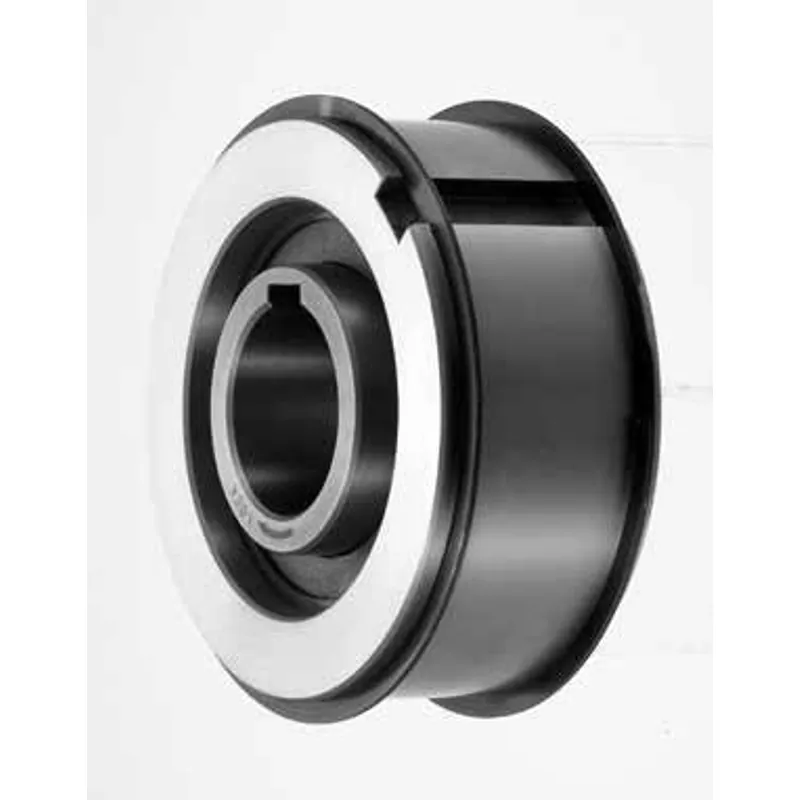
Freewheels: MZ, LD, and other series
Tsubaki freewheels (also called one-way clutches) are identified with prefixes such as MZ, LD, among others. The MZ series is very common in low and medium speed applications, and the following number (e.g., MZ17 or MZ35) relates to the shaft diameter in millimeters or the housing size.
The LD series, such as LD08, usually corresponds to needle freewheels with high torque capacity for their size. It is important not to confuse these series with chain series, because the letters do not repeat with the same meaning.
When quoting a freewheel, it is always advisable to indicate the complete code and, if possible, the shaft and housing dimensions. This avoids errors due to similar series.
Conveyor chains and leaf chains
Tsubaki conveyor chains use prefixes such as M (e.g., M 28, M 56, M 20). In this case, the number does not directly indicate the pitch, but is a model code that defines the pitch, roller diameter, and strength. The M series is very versatile for medium-load conveyors.
Leaf chains (also called steel link chains) are identified with the prefix BL, such as BL 544, BL 823, or BL 466. The number is a series code that defines the pitch and breaking load. These chains are used in lifting and counterweight applications.
In both cases, if you do not have the exact code, you can measure the pitch between pins and the width between inner plates to get close to the correct series. But it is always better to confirm with the catalog or a specialist.
Couplings: CR and other series
Tsubaki couplings are identified with prefixes such as CR, followed by a number indicating the coupling size and, sometimes, the maximum shaft diameter. For example, CR4016 and CR5016 correspond to CR series chain couplings, where 40 and 50 indicate the internal chain pitch (1/2" and 5/8" respectively) and 16 the number of teeth.
This system is very logical: the first number refers to the pitch of the chain used internally, and the second to the number of teeth on the sprocket. Thus you can deduce the allowable torque and dimensions.
When quoting a coupling, besides the code, it is advisable to indicate the diameters of the shafts to be connected and the power to be transmitted. This allows verifying that the coupling is suitable.
Tips for quoting with the correct code
Whenever possible, send a photo of the part along with the code. Often the codes are engraved on the side plates or on the hub, and an image helps confirm the series and detect variants.
If the code is blurry or incomplete, measure the key dimensions: pitch, inner width, roller diameter (for chains), shaft and housing diameter (for freewheels and couplings). With this data, at MR we help you identify the correct alternative.
Remember that Tsubaki has a wide range of products, and sometimes the same code can have variants depending on material or treatment. Therefore, when quoting, specify the application and working conditions.
Frequently asked questions
What does RS mean in a Tsubaki chain?
RS stands for Roller Chain Standard, i.e., standard roller chain. The following number indicates the pitch in eighths of an inch: for example, RS60 is 3/4" pitch.
How do I identify a Tsubaki freewheel?
Tsubaki freewheels usually have prefixes such as MZ or LD, followed by a number. For example, MZ17 or LD08. The number relates to the shaft size or allowable torque.
What is the difference between M conveyor chain and BL leaf chain?
The M series is for roller conveyor chains, used in conveyors. The BL series is for leaf chains (steel links), used in lifting and counterweights. The numbers are model codes, not direct measurements.
How do I read the code of a Tsubaki coupling?
In chain couplings, the prefix CR is followed by a four-digit number: the first two indicate the internal chain pitch (40=1/2", 50=5/8") and the last two the number of teeth. For example, CR4016 is 1/2" pitch with 16 teeth.
Can I quote a Tsubaki product without the complete code?
Yes, you can send a photo of the part or the main measurements (pitch, width, diameters) and at MR we help you identify the correct code and quote the alternative.
Continue here
Need a quote?
Send us the code, size or a photo of the part and we'll quote you shortly.