
Blog
Agri parts: bearings, chains and housings to maximize field productivity
In the agricultural industry, every hour of downtime costs production. We tell you which industrial components are key in harvesters, seeders and grain handling equipment, and how to choose them to avoid premature failures.
Technical team at MR Accesorios Industriales · Updated on September 28, 2026
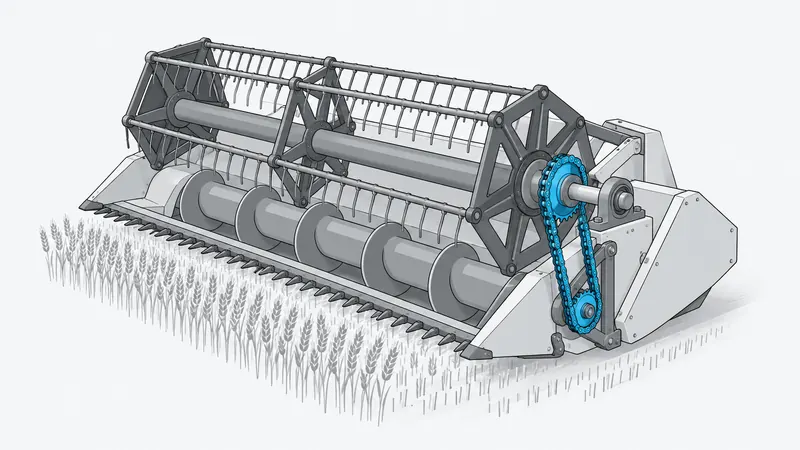
Critical components in agricultural machinery
Agricultural machinery works under demanding conditions: dust, humidity, vibrations and variable loads. Y bearings (inserts) are a common solution in harvesters and seeders because they combine a spherical outer ring with a cast iron or sheet metal housing, which allows absorbing shaft misalignments. At MR we work with recognized brands such as SKF, DODGE and LINK-BELT, and we quote codes like UC 216, INS-GT-09 or ER27.
Y housings with insert bearing simplify assembly and maintenance: they are fixed with set screws or eccentric locking collar and usually have a grease nipple for relubrication. In applications such as augers, bucket elevators or harvester headers, they are a robust and easy-to-replace option. We stock references like TB-GT-04, STMH-35 or P 72.
In addition to bearings, roller chains transmit power in grain elevators, platforms and cleaning systems. Agricultural chains are usually standard pitch (ASA) and can include accessories such as tabs or extended links. We work with SKF, TSUBAKI and EMMAR chains, for example PHC 81X-O/L, RS60 or 12-C1.
Y bearings (inserts) for harvesters and seeders
The Y bearing is named after the shape of its outer ring, which has a spherical raceway to fit into a housing with a concave seat. This allows it to self-align and compensate for small assembly misalignments or shaft flexing. In agriculture they are used in discs, support wheels, fans and gearboxes.
When choosing a Y bearing, it is key to verify the shaft diameter, the locking type (set screws, eccentric or adapter sleeve) and the seal. Triple-lip seals or with metal deflector are preferable in environments with dirt and stubble. At MR we quote options like UC 315 from SKF or ER23 from LINK-BELT, and we advise you on the best alternative for your equipment.
For applications with high radial load and some axial load, Y bearings with cast iron housing are a good choice. The housing can be pillow block, flange or take-up, depending on the mounting. We stock complete assemblies from brands like DODGE and SEALMASTER, for example TB-GT-09 or TBMH-27.
Y housings with insert bearing: simple assembly and maintenance
Y housings with insert bearing combine a gray cast iron or stamped steel housing with an insert bearing. They are popular in agriculture because they install quickly and are replaced without disassembling the entire shaft. The housing is fixed to the structure with bolts, and the bearing is fixed to the shaft with set screws or eccentric collar.
A critical point is lubrication: many housings have a grease nipple, but in highly contaminated environments it is better to use sealed-for-life bearings or with additional seal. At MR we work with SKF, DODGE and SEALMASTER housings, and we quote codes like P 47, TB-GT-04 or STMH-35.
For grain handling equipment, such as augers and bucket elevators, pillow block Y housings are the most common option. If the shaft is subject to misalignment, a self-aligning bearing housing reduces the risk of premature failure. We help you identify the correct reference from the shaft size or the code engraved on the part.
Roller chains for power transmission in agriculture
Roller chains transmit power between parallel shafts in harvesters, seeders and grain handling equipment. They are selected by pitch, number of strands and type of links. In agriculture, ASA 40, 50, 60 and 80 pitches are common, and double-strand chains for higher loads.
Chain wear manifests as elongation: when the pitch increases by more than 2-3%, it should be replaced to avoid damaging the sprockets. At MR we stock chains from brands like SKF, TSUBAKI and EMMAR, for example PHC 40-2C/L, RS25 or 10-C2.
For applications with shock loads or frequent starts, chains with heat treatment and hardened pins are recommended. It is also important to maintain proper lubrication and correct tension. We quote the chain you need by simply indicating the pitch and number of strands, or the original chain code.
Belts and pulleys for transmission in agricultural equipment
V-belts and synchronous belts are common in fans, pumps, compressors and harvester cleaning systems. V-belts are designated by their section (A, B, C, etc.) and length, while synchronous belts are identified by pitch and width.
At MR we work with SKF pulleys and V-belts, such as PHP 6-B68TB or PHP 6-B86TB, and we also stock synchronous belts from various brands. When replacing a belt, it is important to check the condition of the pulleys: a worn pulley reduces the service life of the new belt.
For grain handling equipment, multiple V-belts are common in fans and conveyors. If you need a specific belt, we quote according to section and length, or from the code printed on the old belt. We also advise you on correct tensioning to avoid slipping.
Radial seals: protection against contamination
Radial seals prevent the entry of dirt, water and stubble into bearings and gearboxes. In agricultural machinery, double-lip seals with spring are the most used, as they offer better sealing in abrasive environments.
When replacing a seal, it is essential to verify the shaft diameter, housing diameter and width. The shaft surface must also be checked: if it is scratched or corroded, the new seal will fail prematurely. At MR we stock radial seals from various brands and sizes.
For applications with high exposure to weather, seals with an additional lip or with dust cover can be used. We quote the seal you need by simply indicating the measurements or the original seal code, and we recommend the appropriate material according to the fluid to be sealed.
How to choose the correct spare part and avoid downtime
The first step is to identify the code of the original component. In bearings, it is usually engraved on the side ring; in chains, on the link; in belts, printed on the outer face. If the code cannot be read, the part can be measured: inner, outer diameter and width in bearings; pitch and width in chains; section and length in belts.
At MR we help you cross-reference between brands and find the right alternative. We stock Y bearings, housings, chains, belts and seals for the main brands of agricultural machinery. If you have a photo of the part or the equipment manual, even better.
We work with buyers and maintenance managers throughout Argentina. Send us your inquiry via WhatsApp or email with the code, measurement or a photo, and we will quote you promptly. This way you can plan maintenance and avoid unexpected downtime during the campaign.
Frequently asked questions
What bearing does a harvester use?
It depends on the model and application point. Many harvesters use Y bearings (inserts) with cast iron housing, such as codes UC 216 or TB-GT-04. We recommend verifying the code engraved on the original bearing or measuring the shaft.
How to identify an agricultural roller chain?
Roller chains are identified by pitch (distance between pins) and number of strands. For example, an ASA 60 chain has a 3/4" pitch. If you don't have the code, measure the pitch and count the strands, and with that we will quote the right chain.
What Y housing do I use for a grain auger?
For augers and bucket elevators, pillow block Y housings with insert bearing are usually used, such as those of the SKF P series or those from DODGE and SEALMASTER. The choice depends on the shaft diameter and load. We help you select the correct housing.
When should I replace a V-belt?
When the belt shows cracks, wear on the flanks, or stretches beyond the tensioner adjustment. Also if slipping or squealing is observed. It is advisable to check the pulleys at the same time to avoid premature failures.
What radial seal do I use for a harvester shaft?
The seal must match the shaft diameter, housing diameter and width. In environments with dirt and stubble, a double-lip seal with spring is recommended. If you have the measurements or the original seal code, we will quote the replacement.
Continue here
Need a quote?
Send us the code, size or a photo of the part and we'll quote you shortly.