
Blog
Ruadigon Codes: How to Read Coupling Designations
Practical guide to interpreting Ruadigon codes on elastic couplings. Understand the structure, prefixes, suffixes and real examples to order the correct replacement part.
Technical team at MR Accesorios Industriales · Updated on September 28, 2026
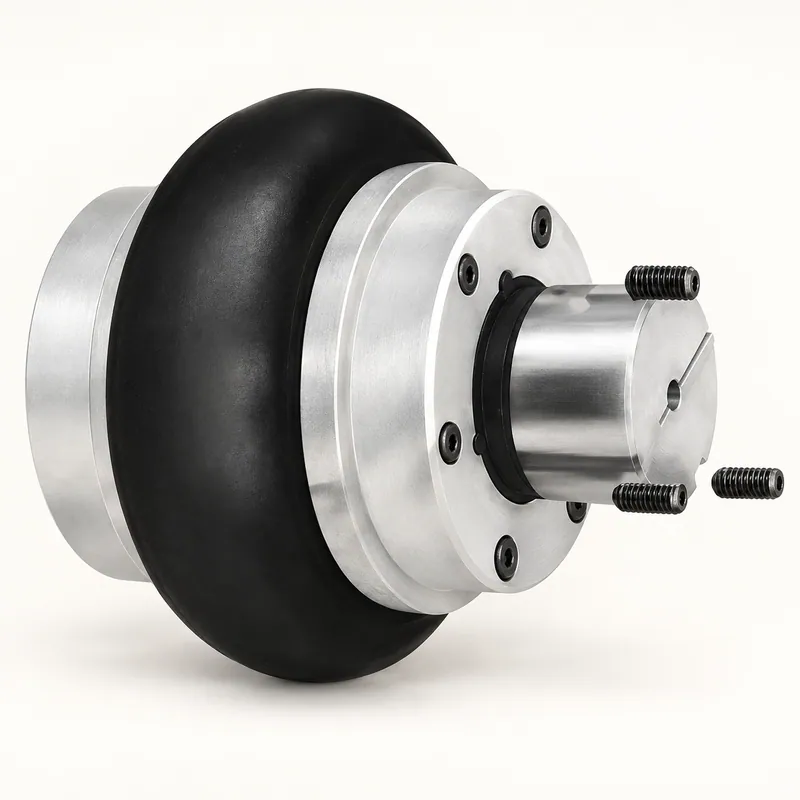
What Ruadigon is and why its nomenclature matters
Ruadigon is a recognized brand in the world of elastic couplings, components that transmit power between shafts while absorbing vibrations and misalignments. In Argentine industry, Ruadigon couplings are found in pumps, compressors, gearboxes and other rotating equipment. Their correct identification is key for maintenance.
Ruadigon codes are not arbitrary: each letter and number provides information about the coupling type, size and elastic element. Understanding this logic allows you to order the exact replacement part without errors, avoiding unnecessary downtime. In this guide we explain how to read them with real examples from the elastic band line.
MR distributes the Ruadigon brand, and from Buenos Aires, Argentina, we help you interpret any designation. If you have a worn part or a manual, with the code or a photo we can quote the corresponding coupling or band.
General structure of a Ruadigon code
A typical Ruadigon code consists of an initial letter indicating the series or coupling type, followed by a number defining the size or model, and sometimes a suffix specifying the elastic element or variant. For example, in the elastic band line, the letter X identifies the series.
The number following the letter is not a direct measurement in millimeters, but a size code within the series. It is important not to assume that a higher number always implies a larger coupling: each series has its own scale. Therefore, you should always verify with the manufacturer's catalog or consult a specialist.
Suffixes such as BE (elastic band) clarify the type of flexible element. This structure allows you to quickly identify whether it is a jaw, band, star or other design coupling. Knowing it saves you time when searching for replacement parts.
Prefixes and series in Ruadigon couplings
The prefix is the first part of the code and is usually a letter or combination of letters. In the examples we handle, the letter X designates the series of couplings with elastic band. Other series may use other letters, but the logic is similar: the prefix groups couplings by design and application.
Within a series, the correlative numbers (such as 1, 6, 7) indicate different sizes. For example, an X-1 coupling is smaller than an X-7. This numbering allows you to select the appropriate coupling according to the torque to be transmitted and the available space.
When reading a Ruadigon code, pay attention to the prefix: if you change the letter, you change the coupling type. If you have doubts about which series corresponds to your application, at MR we guide you with your equipment data.
Suffixes and elastic elements: the case of bands
The suffix in a Ruadigon code specifies the elastic element or some constructional feature. In the examples we see, the suffix BE means 'elastic band'. That is, the coupling uses a rubber band mounted between two hubs that absorbs impacts.
Elastic bands are consumables: they wear with use and must be replaced periodically. Therefore, when ordering a replacement part, it is essential to indicate the complete coupling code, including the suffix, to receive the correct band. An error in the suffix can result in an incompatible part.
In addition to BE, there may be other suffixes for different materials or versions. Always verify the code engraved on the part or on the equipment plate. If you cannot find it, a photo with a reference measurement allows us to identify the model.
Real examples of Ruadigon codes
So you can see the nomenclature in action, we show you three real codes from the elastic band line we distribute:
X-1 · Elastic band: corresponds to a coupling of the X series, size 1, with elastic band. It is the smallest of the three examples, suitable for light applications.
X-6 · Elastic band: coupling of the X series, size 6, with elastic band. Greater torque capacity than the X-1, for medium-sized equipment.
X-7 · Elastic band: coupling of the X series, size 7, with elastic band. The largest of the examples, for applications demanding greater power transmission.
These examples show how the number indicates the size within the same series. If you need a replacement part, copy the code exactly as it appears on the part or in the manual.
How to order the correct replacement part
To get a quote for a Ruadigon coupling or band, you need the complete code. If you do not have it, you can send us a photo of the part with a reference measurement (for example, the outer diameter or the distance between centers). With that we identify the model.
It is also useful to know the application: machine type, motor power and rotation speed. This data allows us to verify that the selected coupling is appropriate, especially if there have been changes in the equipment.
At MR we work with the Ruadigon brand and we quote any reference from its coupling line. Write to us via WhatsApp or email with the code, measurement or a photo, and we will respond promptly.
Common mistakes when reading Ruadigon codes
One of the most frequent mistakes is confusing the series letter. For example, assuming that an X is the same as another letter can lead to ordering an incompatible coupling. Always verify the exact prefix.
Another mistake is ignoring the suffix. The elastic band BE is not interchangeable with other elements, such as stars or jaws. If the original coupling uses a band, the replacement must be a band, not another type.
It is also common to copy the size number incorrectly, especially if the part is worn. If you have doubts, measure the shaft or hub diameter and consult us. We help you confirm the code before buying.
Frequently asked questions
What does the letter X mean in Ruadigon codes?
The letter X identifies the series of couplings with elastic band. Within that series, the numbers indicate the size. For example, X-1, X-6 and X-7 are different sizes of couplings with elastic band.
What is an elastic band in a Ruadigon coupling?
It is the flexible element placed between the coupling hubs to transmit torque and absorb vibrations. It wears with use and must be replaced periodically. The suffix BE in the code indicates that the coupling uses an elastic band.
How do I identify the code of my Ruadigon coupling?
Look for the code engraved on the part or on the equipment plate. If it is not visible, take a photo with a reference measurement and send it to MR. With that we identify the exact model.
Can I use a band of another size on my Ruadigon coupling?
No, each coupling is designed for a specific band according to its size and series. Using an incorrect band can cause premature failures or damage to the equipment. Always use the original replacement part corresponding to the code.
Does MR sell original Ruadigon replacement parts?
Yes, MR distributes the Ruadigon brand and quotes original couplings and elastic bands. Send us the code or a photo via WhatsApp or email and we will respond promptly.
Continue here
Need a quote?
Send us the code, size or a photo of the part and we'll quote you shortly.