
Blog
Food Industry: Stainless Bearings, Hygienic Housings, and Food-Grade Greases
In the food industry, every component must withstand washdowns, moisture, and sanitary demands. We explain which bearings, housings, and lubricants to choose to avoid downtime and contamination.
Technical team at MR Accesorios Industriales · Updated on September 28, 2026
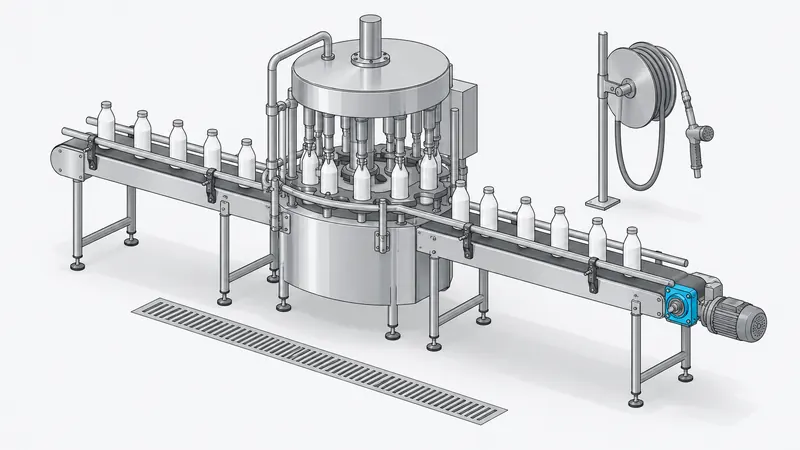
Stainless Bearings for Humid Environments and Frequent Washdowns
In food plants, bearings are exposed to water, steam, and cleaning agents. Therefore, stainless steel deep groove ball bearings are the first choice: they resist corrosion and maintain precision under adverse conditions. We stock references such as W 627 and W 608, ideal for small and medium equipment.
Stainless steel not only prevents rust but also better withstands temperature changes and constant humidity. If your production line has hose washdowns or CIP cleaning, a standard bearing can fail quickly. A stainless bearing, on the other hand, extends service life and reduces the risk of contamination.
In addition to deep groove ball bearings, we work with stainless steel insert bearings (Y-bearings), such as UC 216 and UC 315. These are mounted in housings and allow easy alignment, which is key in conveyor belts and packaging equipment.
Hygienic Housings: Design That Prevents Dirt Accumulation
A conventional housing has corners where product and bacteria accumulate. In the food industry, insert bearing housings with hygienic design are needed, with smooth surfaces and no cavities. We stock options such as TB-GT-04 and TB-GT-09 from DODGE, or STMH-35 and TBMH-27 from SEALMASTER.
These housings are usually made of stainless steel or with special coatings, and their insert bearings come sealed to prevent water and contaminants from entering. The combination of housing and Y-bearing simplifies assembly and maintenance: only the insert is replaced, without disassembling the entire structure.
We also work with pillow block housings such as P 72 and P 47 from SKF, which offer robustness and easy mounting. For high-load or moderate-speed applications, they are a reliable and long-lasting alternative.
Y-Bearings (Insert): The Solution for Long Shafts and Misalignments
Y-bearings, also called inserts, are used with pillow block or take-up housings. Their design allows some angular misalignment, making them ideal for conveyors, screw conveyors, and pumps. We stock references such as INS-GT-09 and INS-GT-05 from DODGE, and ER27 and ER23 from LINK-BELT.
A key advantage is their mounting with set screws or eccentric locking collar, which secures the bearing to the shaft without complicated adjustments. In the food industry, versions with seals and lubricant suitable for incidental food contact are chosen.
If your equipment already has housings and you only need to replace the bearing, we quote the exact insert according to shaft size and housing type. Send us a photo or the code and we will indicate the alternative.
Roller Chains for Transport and Processing: Strength and Cleanliness
Roller chains move products along the line, from washing to packaging. In humid environments, chains with anti-corrosion treatment or stainless steel are needed. We stock SKF chains such as PHC 81X-O/L and PHC 40-2C/L, and also TSUBAKI such as RS60 and RS25.
We also work with EMMAR chains of national manufacture, such as 12-C1 and 10-C2, which offer a good balance between performance and cost for standard applications. Lubrication of these chains must be with food-grade greases to avoid contamination.
Chain wear affects synchronization and can cause downtime. Therefore, we recommend periodically checking elongation and lubrication. If you need to replace a chain, we quote according to pitch and number of strands.
Food-Grade Greases and Lubrication: Safety and Compliance
In the food industry, any lubricant that may come into contact with the product must be food-grade, i.e., registered as H1 by NSF. These greases are formulated to withstand washdowns and be non-toxic in case of incidental contact. We stock special greases and lubricants for bearings, chains, and equipment.
An H1 grease not only protects against corrosion but also withstands high temperatures and loads. It is essential to choose the correct viscosity according to speed and working temperature. If you have doubts, we advise you on which grease to use in your application.
In addition to grease, the lubrication program is important: frequencies, quantities, and methods. Excess grease can generate heat and contamination; lack of grease causes premature wear. We help you define a lubrication plan for your equipment.
Radial Seals: Effective Sealing Against Water and Product Ingress
Radial seals prevent water, dust, or product from entering bearings and causing failures. In the food industry, seals made of materials compatible with sanitary standards, such as nitrile or viton, and with double-lip designs for greater protection are used.
We stock a wide variety of radial seals for shafts of different diameters. If your bearing fails frequently due to contamination, the seal may be worn or improperly installed. Check the seal condition each time you change a bearing.
A well-chosen and mounted seal extends bearing life and reduces the risk of product contamination. We quote seals according to shaft and housing dimensions, and indicate the most suitable material for your process.
How to Choose the Right Bearing for Your Production Line?
To choose the right bearing, consider: load (radial, axial, or combined), speed, temperature, humidity, and sanitary requirements. In the food industry, corrosion resistance and ease of cleaning are priorities.
If your equipment already has a damaged bearing, note the code engraved on the ring or housing. With that data, we quote the exact replacement or an equivalent alternative. You can also send us a photo of the part and shaft dimensions.
We work with stainless bearings, hygienic housings, chains, and food-grade greases. We are from Buenos Aires, Argentina, and serve the entire country. Write to us via WhatsApp or email and we will respond promptly.
Frequently asked questions
What bearing is used in the food industry?
Stainless steel bearings are used, such as stainless deep groove ball bearings or Y-bearings (insert) with seals. Hygienic housings and food-grade greases are also used to comply with sanitary standards.
What is a hygienic housing?
It is a housing designed to prevent the accumulation of dirt and bacteria. It has smooth surfaces, no cavities, and is usually made of stainless steel or with a special coating. It is used with sealed insert bearings.
What grease is used in food equipment?
Food-grade grease, registered as H1 by NSF, must be used. These greases are safe in case of incidental food contact and withstand washdowns and moisture.
How do I prevent contamination in bearings?
Use sealed bearings or with adequate seals, lubricate with H1 grease in the correct amount, and perform preventive maintenance. Check seals and retainers periodically.
Can I replace only the insert bearing without changing the housing?
Yes, Y-bearings (insert) can be replaced individually if the housing is in good condition. You need to know the insert code or the shaft and housing dimensions.
Continue here
Need a quote?
Send us the code, size or a photo of the part and we'll quote you shortly.