
Blog
How to Read Donghua Codes: A Practical Guide to Roller Chain Designation
Understanding Donghua chain nomenclature allows you to identify pitch, series, and construction features. We explain the code structure with real examples.
Technical team at MR Accesorios Industriales · Updated on September 28, 2026
What Does a Donghua Chain Code Indicate?
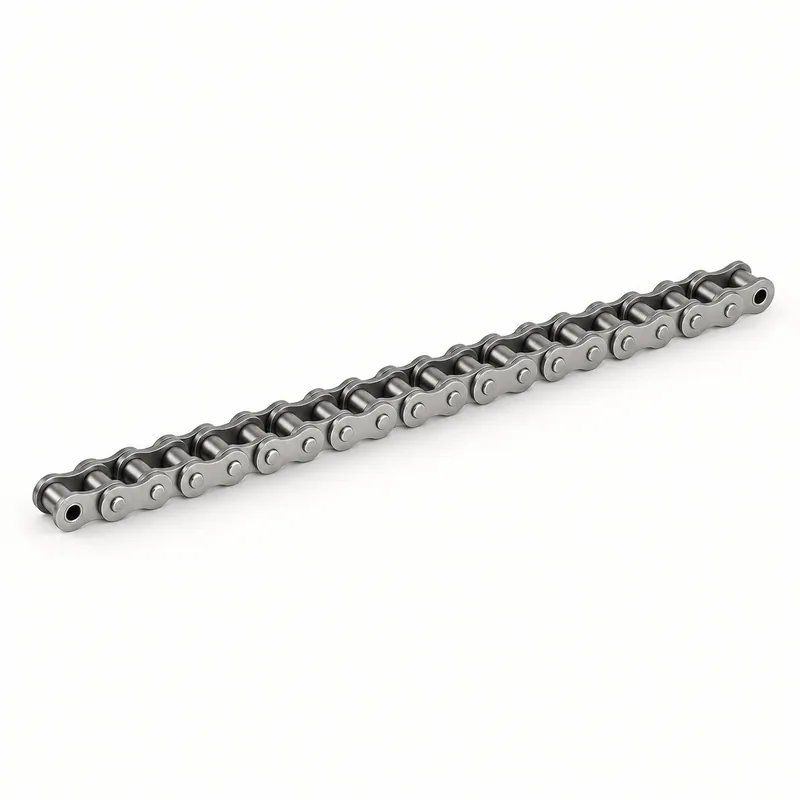
Donghua roller chains follow a standardized nomenclature that allows identification of their main dimensions and construction features. The code consists of an alphanumeric part that defines the series and pitch, and may include suffixes indicating variants such as double-pitch chains or chains with attachments.
For chains in the ASA series, the number following the letters indicates the pitch in eighths of an inch. For example, an ASA 60 chain has a pitch of 6/8 inch, i.e., 3/4 inch. This rule applies to the entire American standard series.
In addition to pitch, the code may include information about the number of roller rows. Single chains do not carry an additional prefix, but double or triple chains are identified with a number before the letters, such as 40-2 or 60-3, indicating the number of rows.
Designation Structure: Prefixes and Suffixes
The designation of a Donghua chain can be divided into three parts: an optional prefix indicating the number of rows, the main code defining the series and pitch, and suffixes indicating special features. For example, a suffix like 'H' may indicate a heavy-duty chain, while 'K' indicates a type of attachment for conveying.
Numeric prefixes are important in applications requiring higher power transmission. A 60-2 chain has two rows of rollers and can withstand higher loads than a single-strand ASA 60 chain. This nomenclature is common in the industry and facilitates selection of the appropriate component.
It is essential to verify the complete code when requesting a spare part, as a difference in a suffix can change the dimensions or strength of the chain. At MR Accesorios Industriales we help you interpret the designation and find the correct chain for your application.
Real Examples of Donghua Codes
To illustrate the nomenclature, let's take some codes we supply. The code ASA 60 corresponds to a roller chain with a pitch of 3/4 inch, widely used in power transmissions for agricultural and industrial machinery. It is one of the most common sizes in the Argentine market.
Another example is the code ASA 50, with a pitch of 5/8 inch. This chain is common in conveying applications and lifting equipment. Its designation follows the same logic: the letters 'ASA' indicate the American standard series and the number 50 indicates the pitch in eighths of an inch.
The code ASA 35, with a pitch of 3/8 inch, is used in lighter applications such as transmission systems in small machinery or production lines with moderate loads. Knowing these examples allows you to quickly recognize the size of a chain when you see its code printed on the links.
Differences Between Donghua Chain Series
Donghua manufactures chains in different series that comply with international standards. The ASA series follows the American standard, while the BS series follows the British standard. Each series has specific pitch and link width dimensions, so they are not interchangeable without verifying compatibility.
Within the ASA series, numbers such as 35, 40, 50, 60, 80, etc., indicate increasing pitches. The higher the number, the greater the pitch and, generally, the greater the load capacity. It is important to select the appropriate chain according to the power to be transmitted and the operating speed.
In addition to standard chains, there are variants such as long-pitch chains, chains with extended pins, or chains with special plates. These variants are identified by additional suffixes in the code, and their correct interpretation is key to avoiding errors in the order.
How to Identify Chain Pitch from Its Code
The pitch of a chain is the distance between the centers of two consecutive pins. In the ASA series, the number in the code indicates the pitch in eighths of an inch. For example, ASA 40 has a pitch of 4/8 = 1/2 inch, ASA 50 has a pitch of 5/8 inch, and ASA 60 has a pitch of 6/8 = 3/4 inch.
For double-pitch chains, the code usually includes a number 2 after the series number, such as 40-2, and the pitch is doubled. These chains are used in conveyors where a larger pitch is required to mount attachments or to reduce chain speed.
If you have doubts about the pitch of your chain, you can measure the distance between three consecutive pins and divide it by two. Then compare that value with standard pitch tables. At MR we help you confirm the size and quote the correct chain.
Common Suffixes and Their Meaning
Suffixes in Donghua codes indicate construction features or special treatments. For example, the suffix 'H' refers to heavy-duty chains, with thicker plates and greater fatigue resistance. The suffix 'K' indicates chains with K-type attachments for conveying.
Other suffixes may indicate chains with stainless steel pins, nickel-plated chains, or chains with special lubrication. It is important to know the meaning of these suffixes to ensure that the chain meets the application requirements, especially in corrosive or high-temperature environments.
At MR Accesorios Industriales we work with the complete line of Donghua chains and can advise you on the appropriate suffix for your needs. If you have your chain code, we will quote it promptly.
Tips for Ordering Your Donghua Chain
When requesting a quote, it is essential to have the complete chain code, including prefixes and suffixes. If you do not have the code, you can send us a photo of the chain or the machine's identification plate, and we will help you identify it.
It is also useful to know the number of links or the total length of the chain, as many chains are sold by the meter or by 10-foot box. If you need a chain with a connecting link, remember to order it separately, as it is not always included.
At MR Accesorios Industriales, based in Buenos Aires, Argentina, we supply Donghua chains throughout the country. You can contact us via WhatsApp or email with the code, size, or a photo of the part, and we will provide a no-obligation quote.
Frequently asked questions
What does ASA mean in a Donghua chain?
ASA indicates that the chain follows the American standard for dimensions. It is equivalent to the ANSI series, commonly used in Argentina and Latin America.
How do I know the pitch of my Donghua chain?
The number in the code indicates the pitch in eighths of an inch. For example, ASA 60 has a pitch of 6/8 inch (3/4 inch). You can measure the distance between pins and compare with standard tables.
What is the difference between ASA 50 and ASA 60?
The main difference is the pitch: ASA 50 has a pitch of 5/8 inch and ASA 60 of 3/4 inch. The inner width and roller diameter also vary, which affects load capacity.
Can I use a BS chain instead of an ASA one?
It is not recommended, as the pitch and width dimensions are different. Always replace with a chain of the same series and size to ensure compatibility with sprockets.
Does Donghua manufacture stainless steel chains?
Yes, Donghua offers stainless steel chains for applications in corrosive or food environments. These chains usually have a specific suffix in their code, such as 'SS'.
Continue here
Need a quote?
Send us the code, size or a photo of the part and we'll quote you shortly.