
Blog
EMMAR: applications, selection and maintenance for lasting performance
EMMAR is MR's own brand for pulleys and roller chains. Learn where they are used, how to select them and maintain them to extend their service life.
Technical team at MR Accesorios Industriales · Updated on September 28, 2026
What is EMMAR and where is it used?
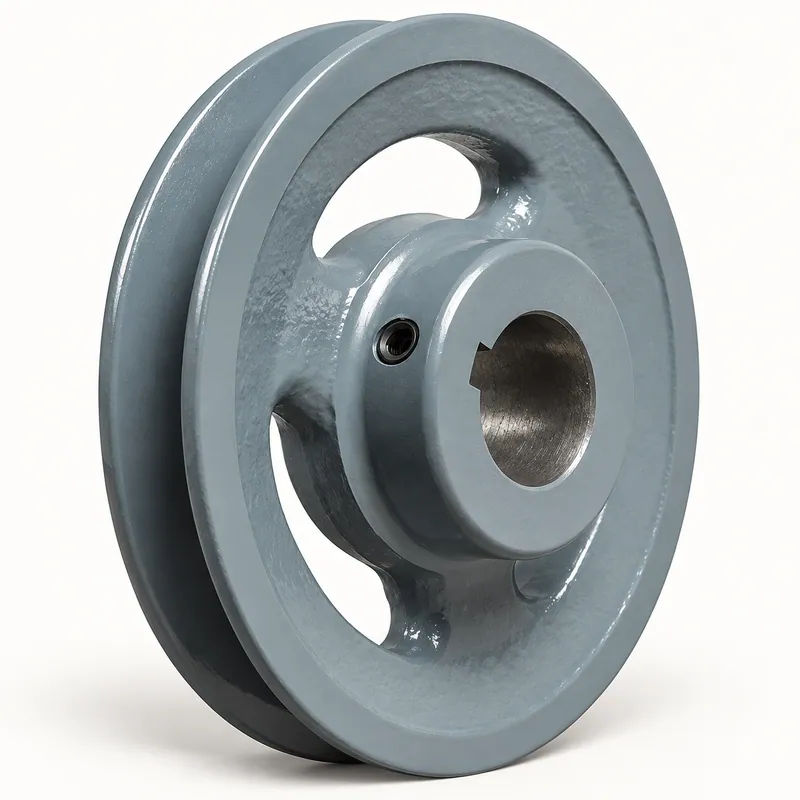
EMMAR is MR's own manufacturing brand, with production in Buenos Aires, Argentina. Under this brand, pulleys and roller chains are manufactured for power transmission in industry. They are mechanical components that transmit motion and force between shafts, and they are found in a wide variety of machines.
EMMAR pulleys are used in belt systems to drive pumps, fans, compressors, conveyors and agricultural machinery. EMMAR roller chains are used in chain drives, such as in elevators, conveyors, motorcycles and industrial machinery where synchronism and high load capacity are required.
Because it is own manufacturing, MR can offer a wide range of sizes and configurations to adapt to the requirements of each application. If you need a specific pulley or chain, you can consult us with the code or the measurements.
EMMAR pulleys: types and selection
EMMAR pulleys are manufactured in different types according to the number of grooves and the belt profile. For example, the code POLEA 50 1B corresponds to a 1-groove pulley for a B belt, while POLEA 70 4B is a 4-groove pulley. The letter indicates the profile (A, B, C, etc.) and the number indicates the number of grooves.
To select a pulley, it is essential to know the pitch diameter, the outside diameter, the groove width, the shaft diameter and the bushing type or fastening. The power to be transmitted and the rotation speed must also be considered, as they determine the number of grooves required.
A common mistake is choosing a pulley only by the outside diameter without verifying the belt profile. If you have doubts, you can send us a photo of the existing pulley or the measurements, and we will help you identify the correct model.
EMMAR roller chains: features and selection
EMMAR roller chains are manufactured in different pitches and configurations. For example, the code 12-C1 indicates a single-strand chain with pitch 12 (3/4"), while 10-C2 is double-strand with pitch 10 (5/8"). The number after the C indicates the number of strands: 1 for single, 2 for double, 3 for triple, etc.
The selection of a chain is based on the power to be transmitted, the rotation speed, the number of teeth on the sprockets and the center distance. The type of lubrication and environmental conditions (dust, humidity, temperature) must also be considered.
It is important to verify the pitch of the chain, which is the distance between centers of consecutive rollers. An incorrect pitch will cause premature wear and drive failures. If you are not sure of the pitch, measure the distance between three rivets and divide it by two.
Correct assembly of EMMAR pulleys and chains
Correct assembly is key to the durability of the components. In the case of pulleys, the alignment between driving and driven pulleys must be verified. Angular or parallel misalignment causes premature wear of belts and pulleys, vibrations and noise.
For chains, tension is critical. A chain that is too tight generates excessive loads on the bearings and accelerated wear; too loose it can jump teeth or come off the sprocket. Correct tension is verified by measuring the sag at the center of the span: it should be approximately 2-3% of the center distance.
In addition, it is essential that the sprockets are aligned in the same plane. Misalignment causes lateral wear on the links and reduces service life. Use a ruler or a laser to verify alignment.
Preventive maintenance to extend service life
Preventive maintenance includes periodic inspection, cleaning and lubrication. On pulleys, the wear of the grooves and the condition of the contact surface must be checked. If the grooves are polished or cracked, it is time to replace the pulley.
On chains, lubrication is essential. A well-lubricated chain reduces friction, dissipates heat and protects against corrosion. It is recommended to lubricate with suitable oil or grease according to speed and load. The frequency depends on operating conditions, but a weekly inspection is good practice.
The elongation of the chain must also be monitored. With use, the pins and bushings wear and the chain elongates. If elongation exceeds 2-3%, the chain must be replaced to avoid damage to the sprockets.
Common problems and solutions
Some common problems with pulleys include excessive vibration, noise and premature belt wear. These are usually due to misalignment, imbalance or incorrect diameter. Check alignment with a ruler and balance the pulley if necessary.
On chains, typical problems are noise, tooth jumping and link breakage. Noise can indicate lack of lubrication or misalignment. Tooth jumping is usually due to insufficient tension or excessive wear. Link breakage can be due to overload or fatigue.
If you detect any of these problems, do not hesitate to consult us. We can help you diagnose the cause and recommend the appropriate solution, whether an adjustment, a repair or replacement of the component.
Why choose EMMAR from MR?
By choosing EMMAR, you are opting for own manufacturing by MR in Buenos Aires, Argentina. This means we have direct control over the quality of materials and manufacturing processes, and we can offer you reliable products for your industry.
In addition, as manufacturers, we can advise you on selecting the correct component for your application. If you need a special pulley or chain, we can evaluate the feasibility of manufacturing it according to your specifications.
We work with a wide variety of sizes and configurations. If you cannot find what you are looking for, send us your inquiry with the code, the measurements or a photo of the part, and we will quote the appropriate option.
Frequently asked questions
What does the code of an EMMAR pulley mean?
The code indicates the type of pulley and the number of grooves. For example, POLEA 50 1B is a 1-groove pulley for a B belt, and POLEA 70 4B is a 4-groove pulley. The letter corresponds to the belt profile (A, B, C, etc.) and the number to the number of grooves.
How do I identify the pitch of an EMMAR chain?
The pitch is the distance between centers of consecutive rollers. You can measure the distance between three rivets and divide it by two. For example, if the distance between three rivets is 1.5 inches, the pitch is 0.5 inches (pitch 08).
How often should I lubricate a roller chain?
It depends on operating conditions. In general, it is recommended to lubricate at least once a week under normal conditions. In dusty or high-temperature environments, the frequency should be higher. Use a suitable chain lubricant.
Can I order an EMMAR pulley or chain with special measurements?
Yes, because it is own manufacturing, we can evaluate the manufacture of pulleys or chains according to your specifications. Send us the measurements or a sample and we will quote the feasibility.
How do I request a quote for EMMAR products?
You can write to us via WhatsApp or email with the product code, the measurements or a photo of the part. We will respond shortly with the corresponding quote.
Continue here
Need a quote?
Send us the code, size or a photo of the part and we'll quote you shortly.