
Blog
Ruadigon Couplings: where they are used, how to select them, installation and maintenance to make them last
Ruadigon elastic couplings are a reliable solution for transmitting power between shafts, absorbing misalignments and vibrations. In this guide we explain how to choose them according to the application, install them correctly and maintain them to extend their service life.
Technical team at MR Accesorios Industriales · Updated on September 28, 2026
What Ruadigon couplings are and why they are used in industry
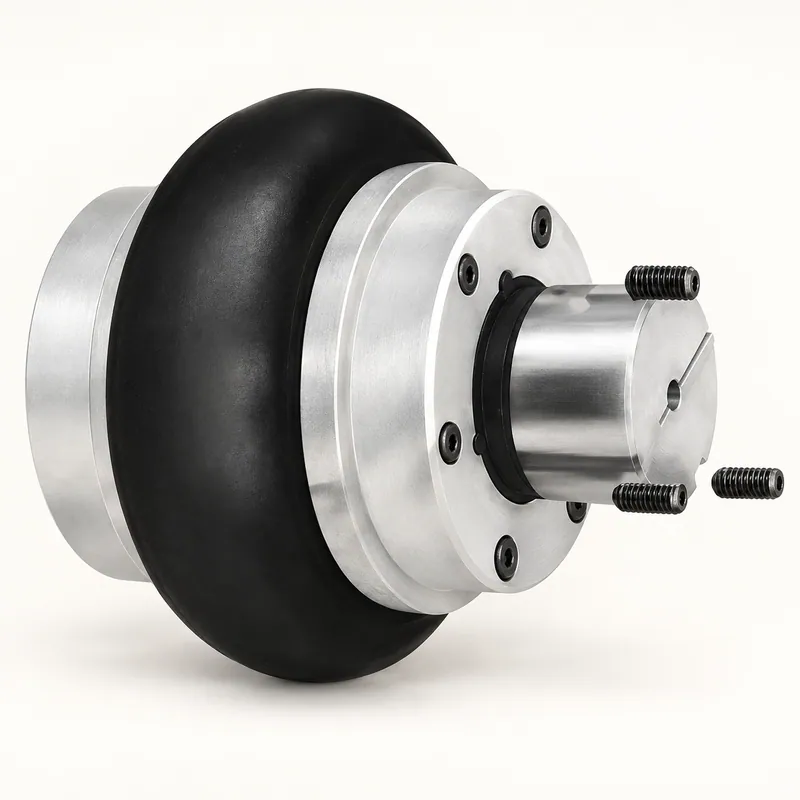
Ruadigon couplings are power transmission elements that connect two shafts to transfer motion and torque. Their design with elastic band allows them to absorb angular, parallel and axial misalignments, as well as dampen vibrations and shocks. This protects the connected equipment, such as motors, pumps and gearboxes, from excessive loads and premature wear.
In Argentine industry, these couplings are used in a wide variety of machines: centrifugal pumps, compressors, conveyors, agitators, fans and more. Their versatility and robustness make them suitable for demanding working conditions, where reliability is key to avoiding unplanned downtime.
MR distributes the Ruadigon couplings line, which includes models such as X-7 · Banda elástica, X-1 · Banda elástica and X-6 · Banda elástica, among others. If you need advice to choose the right coupling, you can write to us with the data of your application.
Typical applications of Ruadigon couplings by industry
Ruadigon elastic couplings adapt to different industrial sectors. In water and effluent treatment plants, they are used in pumps and aerators, where vibration absorption is essential to protect bearings and seals. In the food industry, they are installed in conveyors and mixers, complying with hygiene and ease-of-cleaning requirements.
In oil and gas, these couplings connect motors to pumps and compressors, withstanding variable loads and extreme temperatures. In mining and quarries, they are used in conveyor belts and crushers, where resistance to shocks and misalignments is critical. They are also common in power generation plants, coupling turbines or motors to generators.
Each application requires an analysis of torque, speed and expected misalignment. Therefore, it is important to select the appropriate model and not improvise with a generic coupling.
How to select a Ruadigon coupling: key factors
To choose the correct Ruadigon coupling, you first need to know the nominal and maximum torque of the system, the rotation speed and the shaft diameter. The expected misalignment must also be evaluated: angular, parallel or axial. Couplings with elastic band tolerate certain values, but exceeding them reduces their service life.
Another factor is the service factor, which depends on the type of machine and operating conditions. For example, a centrifugal pump has a lower factor than a ball mill. Multiplying the nominal torque by this factor gives the design torque, which must be less than or equal to the allowable torque of the coupling.
At MR we help you size the coupling according to your application. You can send us the motor nameplate data, the driven equipment and the working conditions, and we will indicate the most suitable Ruadigon model.
Correct installation of Ruadigon couplings: step by step
Proper installation is essential for the coupling to work well and last. First, verify that the shafts are clean and free of burrs. Then, mount the hubs on each shaft, respecting the distance between ends indicated by the manufacturer. Tighten the set screws to the recommended torque.
Next, place the elastic band between the hubs. It is important not to force it: it should fit without stretching excessively. If the band is twisted or poorly seated, vibrations and premature wear are generated. Finally, align the shafts with a dial indicator or straightedge, seeking the least possible misalignment.
A common mistake is to install the coupling with misaligned shafts and trust that the elastic band will compensate for everything. Although it tolerates some misalignment, always working at the limit shortens the life of the elastic element and can damage the equipment bearings.
Preventive maintenance of Ruadigon couplings
Maintenance of Ruadigon couplings focuses on periodic inspection of the elastic band and verification of alignment. It is recommended to visually inspect the coupling periodically, looking for cracks, uneven wear or hardening of the elastomer. If the band shows damage, it must be replaced immediately.
The tightness of the set screws must also be checked, as they can loosen with vibrations. A good practice is to mark them with paint to detect movement. In addition, alignment should be measured with instruments whenever the equipment is serviced or the band is changed.
A predictive maintenance plan, with vibration analysis, allows detecting incipient misalignments before they cause major failures. At MR we can advise you on the best practices for your installation.
Advantages of Ruadigon couplings compared to other types
Ruadigon elastic couplings offer several advantages. Their elastic band acts as a mechanical fuse: under severe overload, it breaks first and protects the more expensive components, such as motors or gearboxes. In addition, since they do not require lubrication, they eliminate greasing tasks and reduce maintenance cost.
Compared to rigid couplings, Ruadigon couplings tolerate misalignments and absorb impacts, which extends bearing life. Compared to chain couplings, they are quieter and do not need lubrication. And compared to gear couplings, they are lighter and cheaper to maintain.
In summary, they are a robust and practical option for most industrial applications. If you are evaluating changing the type of coupling in your machine, consult us about Ruadigon alternatives.
Where to buy Ruadigon couplings in Argentina
MR, from Buenos Aires, Argentina, distributes the complete line of Ruadigon couplings, including models such as X-7 · Banda elástica, X-1 · Banda elástica and X-6 · Banda elástica. We work with workshops, factories and maintenance companies throughout the country.
To get a quote, you can write to us via WhatsApp or email indicating the coupling code, shaft dimensions or a photo of the part to be replaced. We will respond promptly with the proposal and estimated delivery time.
Do not hesitate to consult us for technical advice: selection, installation or maintenance. Our team knows the applications and can help you choose the right Ruadigon coupling for your needs.
Frequently asked questions
What is a Ruadigon coupling?
It is an elastic coupling that transmits power between two shafts through an elastomer band. It absorbs misalignments and vibrations, protecting the connected equipment.
How do I select the correct Ruadigon coupling?
You need to know the torque, speed, shaft diameter and expected misalignment. With this data, the design torque is calculated and the model that supports it is chosen. At MR we advise you free of charge.
How often should I check the elastic band of the coupling?
It depends on working hours and conditions. A monthly visual inspection and an alignment check every six months or when there are abnormal vibrations are recommended.
Do Ruadigon couplings need lubrication?
No, couplings with elastic band do not require lubrication. This simplifies maintenance and prevents grease or oil leaks in the work area.
Can I replace only the elastic band of a Ruadigon coupling?
Yes, the band is an independent spare part. It can be changed without dismounting the hubs, as long as the model and original hardness are respected. At MR we quote the band according to the coupling code.
Continue here
Need a quote?
Send us the code, size or a photo of the part and we'll quote you shortly.